

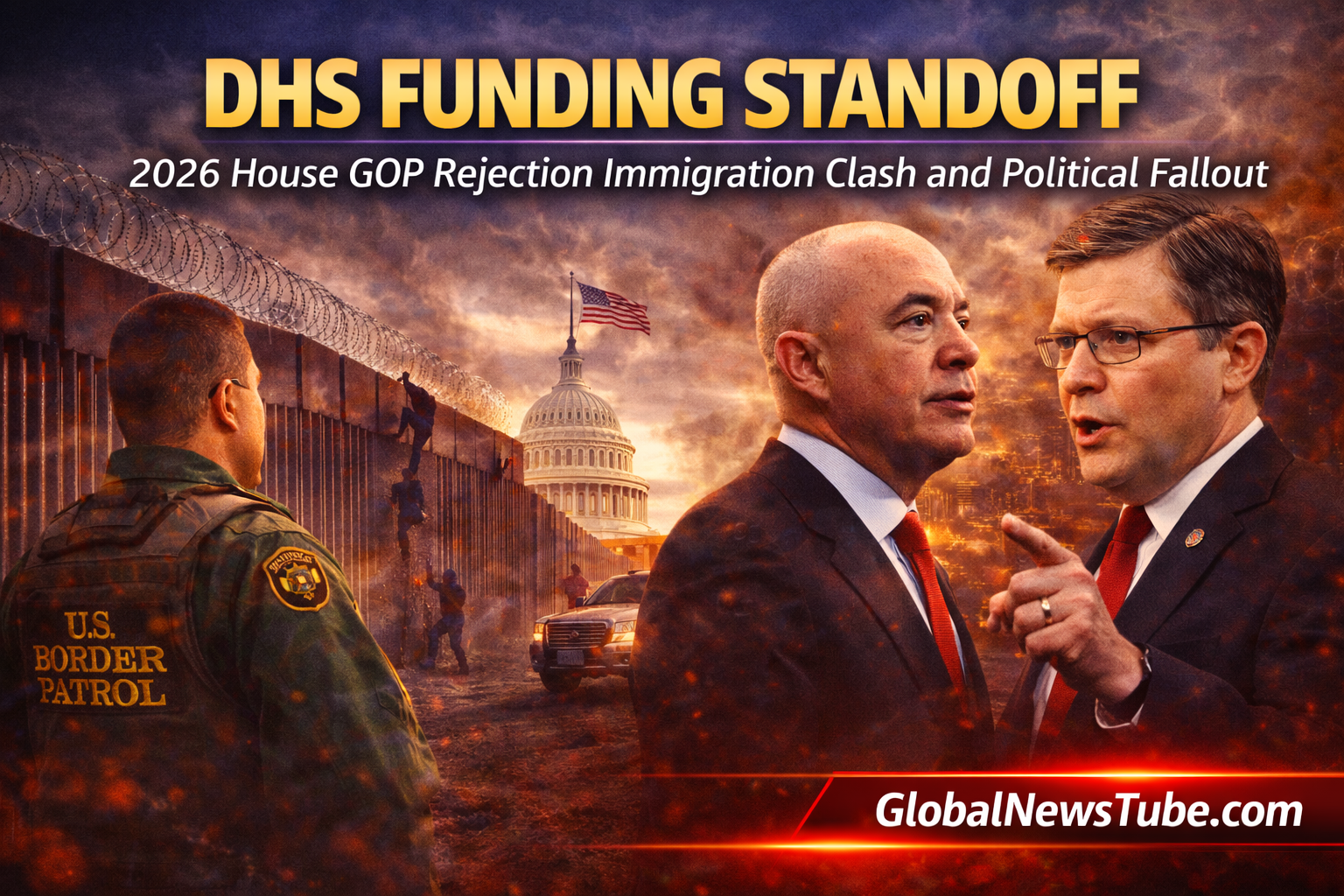
The DHS funding standoff in 2026 has become a major political crisis in the United States, exposing deep divisions over immigration policy and federal spending. The decision by House Republicans to reject a Senate approved funding bill has prolonged a partial shutdown of the Department of Homeland Security, affecting national security operations and federal workers.
This article examines the causes, political dynamics, economic consequences, and future outlook of the crisis.
What Is the DHS Funding Standoff
The standoff began when Congress failed to pass a full year funding bill for the Department of Homeland Security before the deadline, triggering a partial shutdown. While most federal agencies continued operating, DHS was left without full appropriations.
The situation escalated after the Senate passed a funding proposal that excluded certain immigration enforcement components. House Republicans rejected the bill, arguing that it did not adequately support border security and enforcement efforts.
As a result, lawmakers have been unable to reach an agreement, prolonging the shutdown and increasing pressure on both parties.
Why House Republicans Rejected the DHS Bill
The rejection centers on disagreements over immigration enforcement funding.
House Republicans insisted that any funding measure must fully support agencies responsible for border control and immigration enforcement. They argued that excluding or limiting funding for these agencies would weaken national security.
Instead of accepting the Senate proposal, House leaders introduced a short term funding plan aimed at keeping DHS operational while negotiations continue. However, this approach has not been accepted by the Senate, contributing to the ongoing deadlock.
This dispute reflects broader political differences over how immigration policy should be managed in the United States.
Role of Donald Trump in the Crisis
President Donald Trump has played a visible role in the standoff.
With Congress unable to reach a deal, the administration took steps to ensure that certain essential workers, particularly in airport security, continued to receive pay during the shutdown. This was presented as a necessary measure to maintain stability in critical services.
At the same time, the president has supported the position that stronger funding for immigration enforcement is essential. This alignment with House Republicans has reinforced the administration stance in the negotiations.
However, executive actions alone cannot resolve the broader funding issue, leaving the core dispute in the hands of Congress.
Impact on Federal Workers and Public Services
The shutdown has had significant consequences for federal employees and public services.
Many DHS workers have been required to continue working without pay, creating financial strain and uncertainty. This has affected morale and raised concerns about workforce stability.
Airport security operations have experienced disruptions, with reports of longer wait times and staffing challenges. Other areas, including disaster response coordination and administrative services, have also been affected.
The longer the shutdown continues, the more pressure it places on both employees and the systems they support.
Immigration Policy Conflict at the Core
At the heart of the standoff is a fundamental disagreement over immigration policy.
One side argues that strong enforcement measures are necessary to maintain border security and uphold the law. The other side emphasizes the need for oversight, reforms, and a more balanced approach to immigration enforcement.
These opposing views have made compromise difficult. Each side sees the issue as central to broader national priorities, which increases the stakes of the disagreement.
As a result, negotiations have repeatedly stalled, with neither side willing to fully its position.
Political and Economic Implications
The crisis highlights the challenges of governing in a highly polarized political environment.
Politically, both parties have used the standoff to reinforce their positions and appeal to their supporters. The issue has become part of a larger debate about national identity, security, and government responsibility.
Economically, the shutdown creates uncertainty for federal workers and can disrupt services that support travel, trade, and public safety. While the immediate financial impact may be limited compared to a full government shutdown, the long term effects could be more significant if the situation persists.
Legislative Deadlock and Failed Negotiations
Efforts to resolve the standoff have so far been unsuccessful.
The Senate and House have proposed different funding approaches, but neither has been able to secure enough support across both chambers. This has led to a cycle of proposals and rejections, with no clear resolution.
Breaks in the legislative calendar and competing political priorities have also slowed progress. As time passes, the lack of agreement continues to affect operations and public confidence.
Future Outlook What Happens Next
The outcome of the standoff will depend on whether lawmakers can find common ground.
One possible scenario is a temporary funding agreement that allows DHS to resume normal operations while broader policy debates continue. Another possibility is a prolonged deadlock, which could increase pressure on both parties to compromise.
External factors, including public opinion and economic conditions, may also influence the direction of negotiations.
The DHS funding standoff in 2026 reflects deeper political divisions over immigration and federal priorities. The rejection of the Senate bill by House Republicans has extended the crisis, affecting workers and key government functions.
While short term solutions may provide temporary relief, resolving the underlying issues will require compromise and cooperation. The outcome of this standoff will likely have lasting implications for US politics and governance.


