

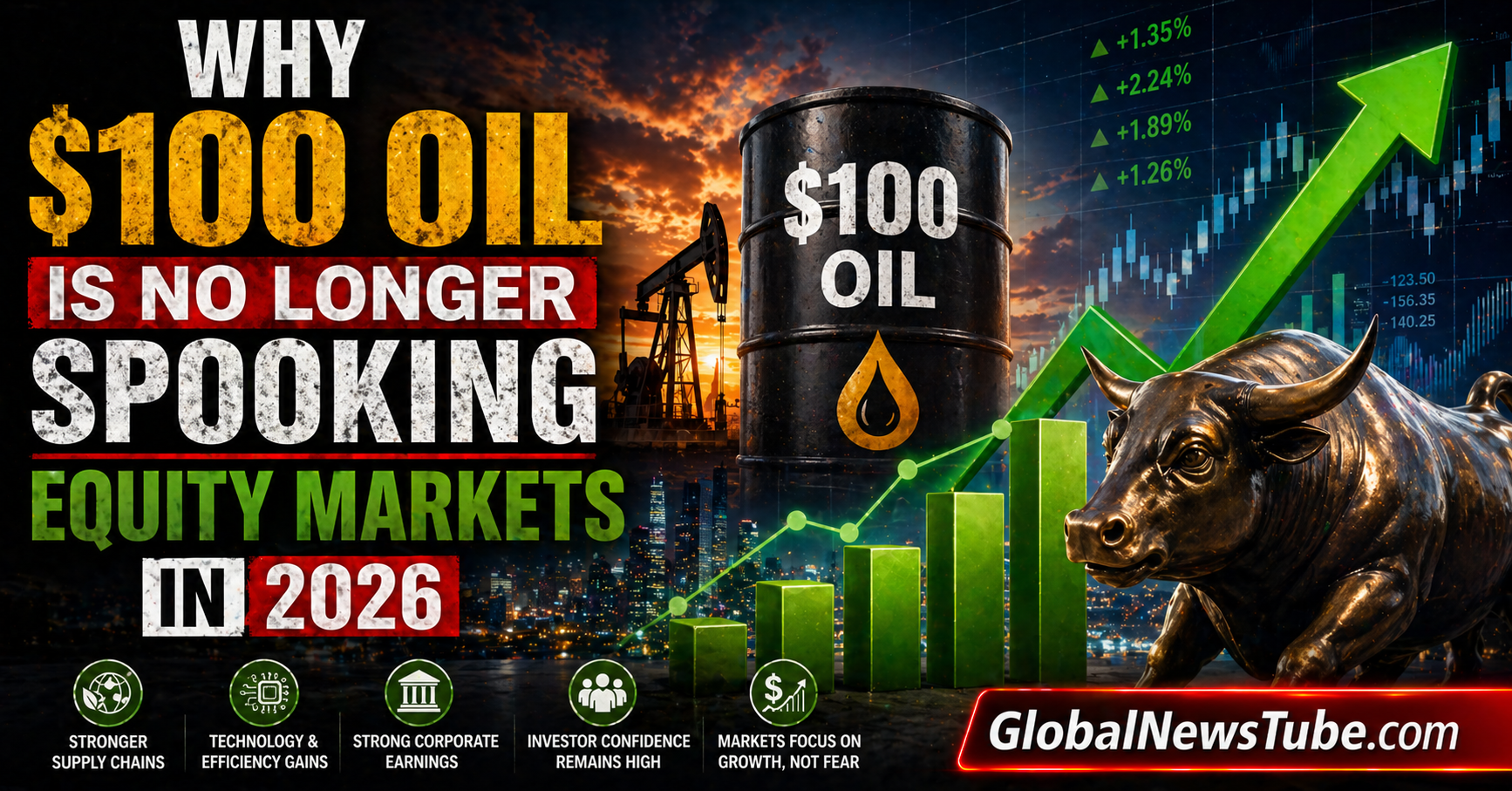
The surge in global oil prices above $100 per barrel would once have sent shockwaves through equity markets, triggering sell-offs and recession fears. However, in 2026, financial markets are reacting very differently. Despite oil prices climbing sharply amid geopolitical tensions and supply disruptions, equity markets have shown remarkable resilience. Investors appear less fearful of high oil prices than in previous decades, signaling a structural shift in how global economies absorb energy shocks.
Oil Price Surge and Market Reaction
The recent spike in oil prices has been driven largely by geopolitical tensions, particularly conflicts affecting major oil producing regions and key supply routes such as the Strait of Hormuz. Brent crude has surged well above $100 per barrel, even reaching higher levels during peak tensions. Historically, such increases would have caused equity markets to decline sharply. Yet, global stocks have remained relatively stable, with some indices even performing strongly despite ongoing uncertainty. This shift highlights a fundamental change in market behavior.
Declining Oil Dependence in the Global Economy
One of the main reasons behind this resilience is the reduced dependence of the global economy on oil. Compared to earlier decades, economies today use less oil per unit of economic output. Improvements in energy efficiency, the adoption of alternative energy sources, and advancements in technology have all contributed to this transition. As a result, even significant increases in oil prices have a smaller impact on overall economic performance.
The Shift Toward Service Based Economies
Another major factor is the transition of large economies toward service oriented industries. Sectors such as technology, finance, and healthcare dominate modern economies and are less sensitive to energy price fluctuations. Unlike heavy manufacturing industries, these sectors rely more on human capital and digital infrastructure, reducing their exposure to rising oil costs. This structural shift has helped protect equity markets from energy driven shocks.
Inflation Adjustments and Real Price Perspective
Although $100 oil may appear high, its real value is lower when adjusted for inflation. In comparison to historical oil price spikes, current levels are less extreme in real terms. This reduces the psychological impact on investors, who are now more accustomed to higher nominal prices. As a result, oil at this level is increasingly seen as manageable rather than alarming.
U.S. Energy Independence and Market Stability
The rise of energy independence in major economies has also contributed to market stability. Increased domestic oil production has reduced reliance on imports, allowing economies to better withstand global supply disruptions. This self sufficiency strengthens investor confidence and helps stabilize financial markets even during periods of volatility in oil prices.
Strong Economic Fundamentals
Global economic conditions have remained relatively strong, supporting equity markets despite rising oil prices. Continued growth in key sectors, steady corporate earnings, and ongoing investment in innovation have all played a role in maintaining market stability. These factors have helped offset concerns about energy costs and contributed to a more balanced economic outlook.
The Role of Technology and Innovation
Technology continues to be a major driver of economic resilience. Companies in the technology sector have maintained strong performance, supported by demand for digital services, artificial intelligence, and cloud computing. These industries are less dependent on energy prices, allowing them to thrive even when oil costs rise. This shift has reduced the overall sensitivity of equity markets to oil price movements.
Geopolitical Risks and Market Adaptation
While geopolitical tensions still pose risks, markets have become more adaptable to such uncertainties. Investors now tend to view geopolitical events as temporary disruptions rather than long term threats. This change in perception has led to more measured market reactions, preventing the sharp declines that were once common during periods of rising oil prices.
Regional Differences in Market Impact
The effects of high oil prices are not uniform across all regions. Some economies remain more vulnerable due to their dependence on energy imports. In these regions, rising oil prices can lead to higher inflation and slower economic growth. However, even in these cases, equity markets have not experienced the same level of disruption as in past oil crises, reflecting improved resilience.
The Threshold for Market Concern
Despite current stability, there is still a level at which oil prices could significantly impact equity markets. Extremely high and sustained price increases could place pressure on global growth and trigger broader economic challenges. However, current price levels are generally considered manageable given the structural changes in the global economy.
Investor Behavior and Market Psychology
Investor behavior has evolved significantly over time. Modern investors focus more on long-term fundamentals and less on short-term price fluctuations. This shift has reduced the likelihood of panic selling in response to rising oil prices. Instead, investors are more likely to reassess opportunities and adjust their strategies based on broader economic trends.
Supply Chain Adjustments and Energy Diversification
The global economy has become more resilient due to improved supply chain management and energy diversification. Countries and companies have invested in alternative energy sources and built strategic reserves to mitigate the impact of supply disruptions. These efforts have reduced vulnerability to oil price volatility and contributed to overall economic stability.
Global Economic Risks Remain
Despite the resilience of equity markets, risks still exist. Prolonged supply disruptions, escalating geopolitical tensions, and tightening financial conditions could challenge global growth. Rising inflation and interest rates are additional factors that could influence market performance. However, these risks are currently balanced by strong economic fundamentals and investor confidence.
Future Outlook for Oil and Equity Markets
The relationship between oil prices and equity markets is likely to continue evolving. As economies become more diversified and less dependent on fossil fuels, the influence of oil price fluctuations may continue to decline. However, geopolitical developments and supply dynamics will remain important factors shaping market trends in the future.
The impact of $100 oil on equity markets has changed significantly in recent years. Structural shifts in the global economy, including reduced oil dependence, technological advancements, and stronger economic fundamentals, have made markets more resilient. While challenges remain, the current environment reflects a new reality in which high oil prices no longer dominate market sentiment as they once did.


