


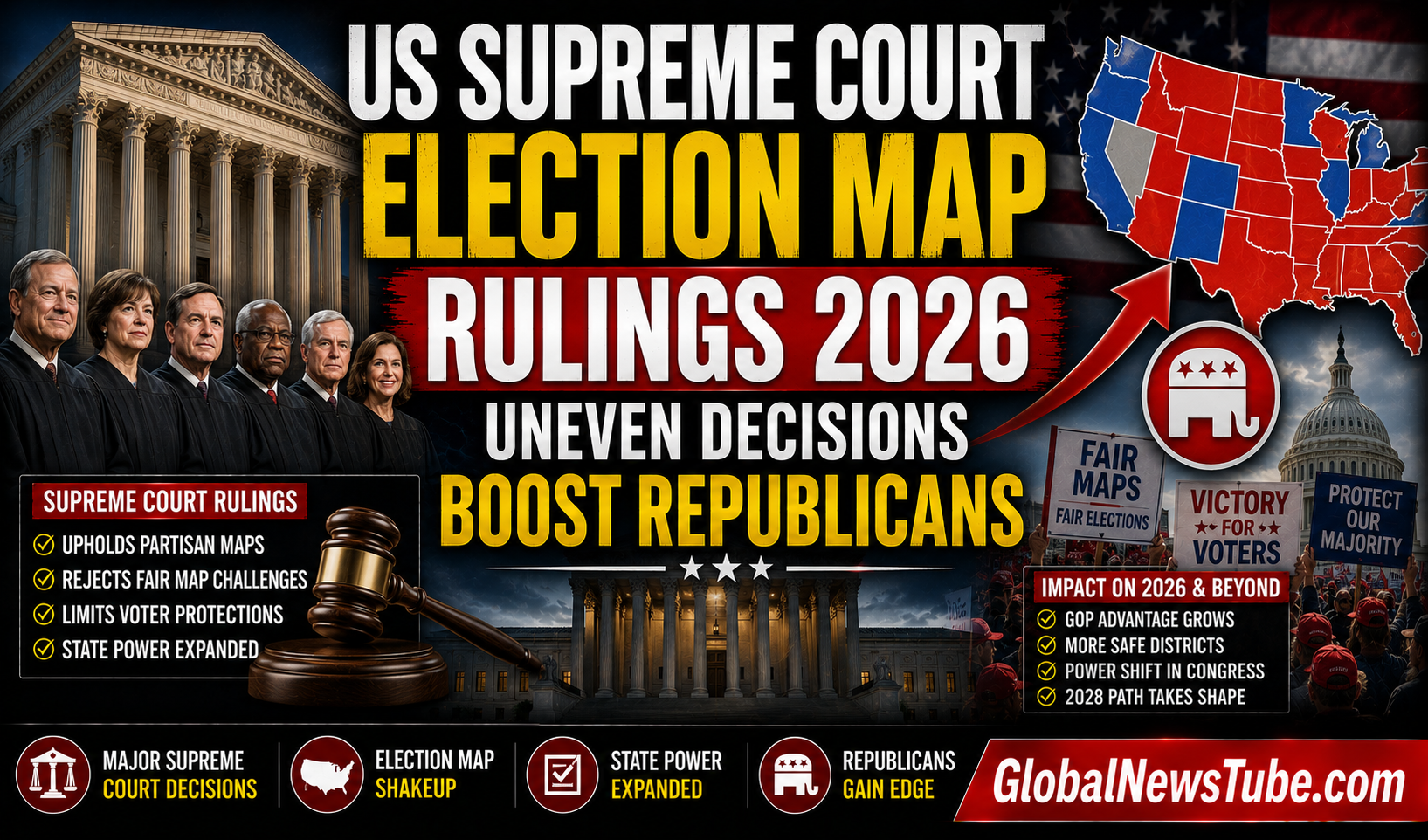
The US Supreme Court election map rulings 2026 have sparked intense debate across the political spectrum, as recent decisions appear to favor Republican led redistricting efforts. With the balance of power in Congress at stake, the court approach to electoral maps has become a defining issue in American politics. Critics argue that inconsistent rulings are undermining fair representation, while supporters claim the court is respecting state authority.
As the 2026 election cycle unfolds, these rulings could significantly shape the political landscape, influencing congressional control, voter representation, and the broader democratic process.
Understanding Election Map Rulings in the US
Election map rulings, often referred to as redistricting decisions, determine how electoral district boundaries are drawn. These maps directly impact which party holds political power by shaping voter distribution across districts.
In the United States, redistricting typically occurs after the census and is largely controlled by state legislatures. However, disputes frequently arise when one party is accused of manipulating boundaries commonly known as gerrymandering to gain an advantage.
The Supreme Court plays a critical role in resolving these disputes. However, the US Supreme Court election map rulings 2026 reveal a pattern where similar cases have received different outcomes, raising concerns about consistency and fairness.
Uneven Supreme Court Decisions Raise Concerns
One of the most controversial aspects of the recent rulings is their inconsistency. In some states, the Supreme Court has allowed Republican backed maps to stand, even when challenged for alleged partisan bias. In others, the court has taken a more limited approach or declined to intervene.
This uneven pattern has led critics to argue that the court is applying legal principles inconsistently. They believe that such inconsistency weakens public trust in the judiciary and creates uncertainty about how future cases will be handled.
Supporters, however, argue that each case is unique and must be judged on its own legal and constitutional merits. They maintain that the court is exercising restraint and respecting the role of state governments in managing elections.
How Rulings Benefit Republican Redistricting Efforts
The impact of the US Supreme Court election map rulings 2026 has been particularly beneficial for Republican led states. By allowing certain contested maps to remain in place, the court has strengthened Republican electoral positioning in several key regions.
These maps can concentrate opposition voters into fewer districts while distributing Republican voters across multiple districts more efficiently. As a result, Republicans may secure more seats even in closely contested states.
Political analysts suggest that these rulings could play a crucial role in determining control of the House of Representatives, where even small shifts in seat distribution can have major consequences.
Legal Arguments Behind the Court Approach
The Supreme Court decisions are grounded in complex legal arguments related to federalism, constitutional interpretation, and judicial authority. One key issue is whether federal courts should intervene in cases of partisan gerrymandering.
In earlier rulings, the court indicated that partisan gerrymandering claims may not be suitable for federal judicial review, leaving such matters largely to state courts and legislatures. This perspective has influenced the US Supreme Court election map rulings 2026, where the court has often avoided direct involvement.
Additionally, the court has emphasized the need for clear legal standards. Without a consistent definition of unfair partisan advantage, the justices have been cautious about setting broad precedents.
Political Reactions and Public Debate
The reaction to these rulings has been sharply divided. Democrats and voting rights advocates argue that the decisions enable partisan manipulation and weaken democratic fairness.
They have called for new legislation to establish clearer redistricting rules and limit gerrymandering. Some have also suggested reforms aimed at increasing transparency and accountability in the judicial process.
Republicans, on the other hand, have supported the rulings, viewing them as a defense of state authority. They argue that redistricting is inherently political and should remain under the control of elected officials.
Public opinion remains mixed, reflecting broader political divisions over how elections should be managed and regulated.
Impact on the 2026 and 2028 Elections
The consequences of the US Supreme Court election map rulings 2026 are expected to extend well beyond the current election cycle. By shaping district boundaries now, these decisions will influence electoral outcomes for years to come.
In the short term, Republicans may gain an advantage in congressional races, potentially affecting legislative priorities and policymaking. In the long term, these rulings could shape how future redistricting disputes are addressed.
Looking ahead to the 2028 elections, both parties are likely to intensify their focus on redistricting strategies, making legal battles over electoral maps a continuing feature of American politics.
The Future of Redistricting in America
The debate over redistricting continues to evolve. Advances in data analysis and mapping technology have made it easier to draw precise electoral boundaries, raising concerns about fairness and transparency.
Some states have introduced independent redistricting commissions to reduce partisan influence. While these efforts show promise, their effectiveness varies depending on implementation and oversight.
The US Supreme Court election map rulings 2026 have underscored the need for clearer guidelines and more consistent legal standards to ensure fair representation.
The US Supreme Court election map rulings 2026 mark a significant moment in the ongoing debate over electoral fairness in the United States. The court uneven approach has raised important questions about judicial consistency, political influence, and the balance between federal and state authority.
While the immediate impact may benefit Republicans, the broader implications extend to the integrity of the democratic system. As discussions around redistricting continue, the need for transparency, fairness, and accountability remains central to the future of American elections.