


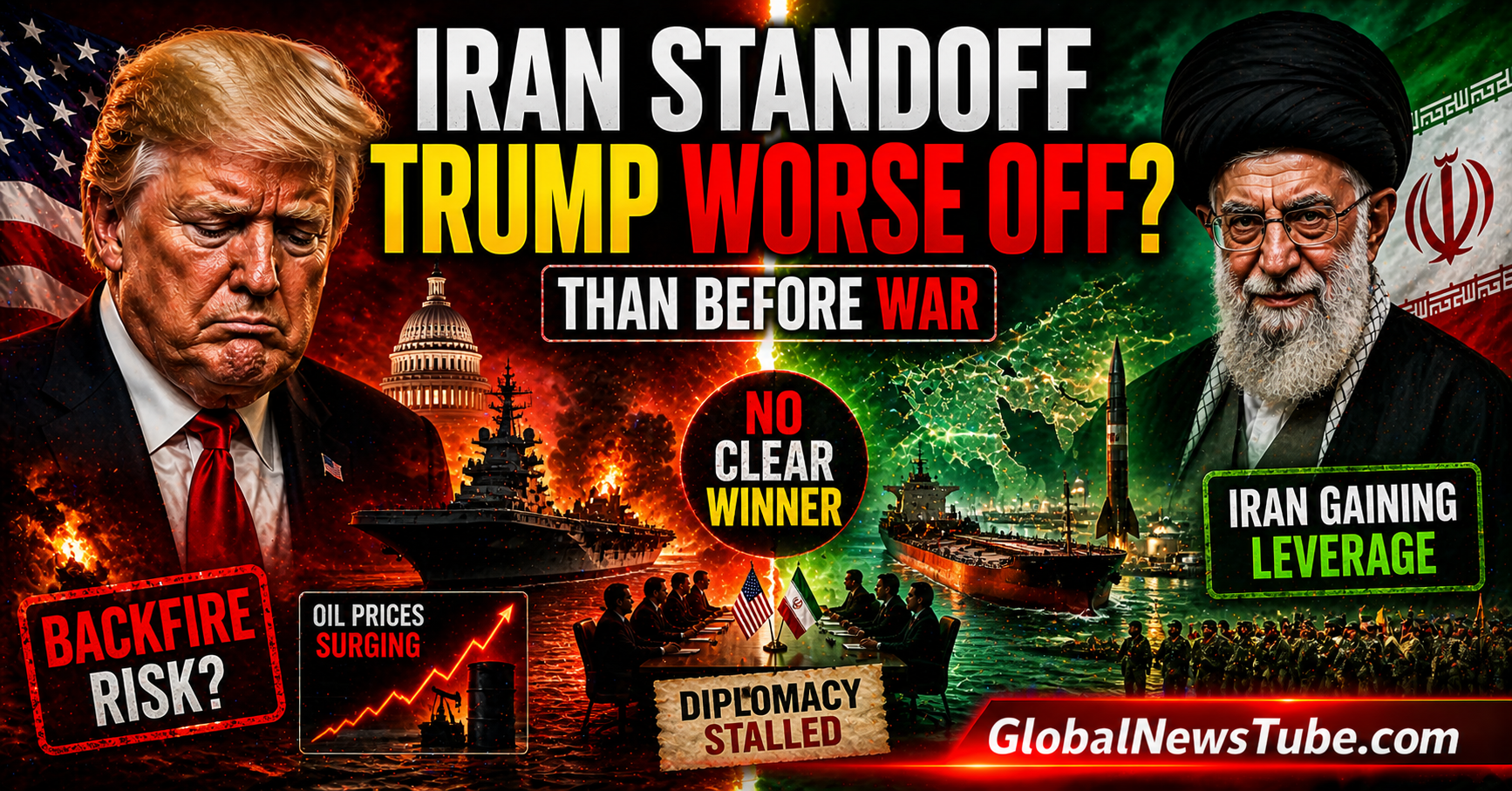
The ongoing standoff between the United States and Iran is emerging as a complex geopolitical crisis that could leave Donald Trump politically and strategically weaker than before the conflict began. What initially appeared to be a decisive show of force has instead evolved into a prolonged confrontation with no clear resolution. As ceasefire talks stall and tensions persist, analysts warn that the United States may face mounting economic, diplomatic, and political costs.
Background of the Iran Conflict
The current crisis began in early 2026 when the United States, alongside allies, launched strikes on Iranian targets. Iran responded with retaliatory actions, including missile attacks and disruptions to key shipping routes.
One of the most critical developments was Iran’s influence over the Strait of Hormuz, a vital global oil transit route. This development significantly impacted international energy markets and increased global economic uncertainty.
Despite early claims of success, the conflict quickly turned into a stalemate, with both sides unable to achieve decisive outcomes.
Stalemate and Lack of Clear Victory
More than two months into the conflict, there is no clear winner. The United States has not achieved key objectives such as dismantling Iran’s nuclear capabilities or forcing major political concessions. Meanwhile, Iran has demonstrated resilience, maintaining its strategic position despite economic and military pressure.
The situation has led to what experts describe as a prolonged stalemate, where neither side is willing or able to escalate significantly, yet no meaningful peace agreement is in sight.
Trump Rejection of Iran Proposal
Efforts to restart negotiations have faced significant setbacks. Donald Trump recently rejected a new Iranian proposal for talks, expressing dissatisfaction with its terms.
This rejection underscores the deep divisions between the two sides. While Iran has signaled willingness to negotiate under certain conditions, the United States continues to demand broader concessions, particularly regarding nuclear activities and regional influence.
Economic Impact and Rising Oil Prices
One of the most immediate consequences of the standoff has been its impact on global energy markets. Disruptions in the Strait of Hormuz have reduced oil supply, leading to higher prices worldwide.
Rising fuel costs have had a direct impact on consumers, particularly in the United States, where gasoline prices have increased significantly. This economic pressure has contributed to declining public support for the conflict and raised concerns about inflation and economic stability.
Domestic Political Pressure
The prolonged conflict is also affecting Donald Trump politically. Approval ratings have declined as the crisis continues without a clear resolution.
With elections approaching, the administration faces increasing scrutiny from both political opponents and members of its own party. Critics argue that the conflict lacks a clear strategy and question whether the costs outweigh the benefits.
Strained Relations with Allies
The Iran standoff has also strained relationships between the United States and its allies. European nations have expressed concerns about the direction of the conflict and the absence of a clear exit strategy.
In some cases, disagreements have led to tensions within alliances, with partners questioning leadership decisions. These divisions could have long-term implications for international cooperation and global security frameworks.
Military Strategy and Limitations
While the United States has demonstrated significant military capability, the conflict has highlighted the limitations of military power in achieving political objectives.
Iran’s ability to disrupt shipping routes and maintain regional influence shows that asymmetric strategies can counter conventional military advantages. Analysts note that a full scale escalation remains unlikely due to the high risks involved.
This has left the United States with limited options, ranging from continued pressure to potential de-escalation.
Iran Strategic Leverage
Despite facing economic sanctions and military strikes, Iran has retained significant leverage in the conflict. Control over key shipping routes and the ability to influence regional dynamics have allowed Tehran to maintain its position.
Experts believe Iran is relying on the United States political and economic vulnerabilities, expecting that prolonged pressure will eventually force a shift in strategy.
This approach highlights the importance of endurance in modern geopolitical conflicts.
Ceasefire and Diplomatic Uncertainty
Although a temporary ceasefire has reduced direct hostilities, it has not resolved the underlying issues. Negotiations remain stalled, with both sides holding firm on key demands.
The absence of a clear diplomatic pathway raises the risk of renewed escalation, particularly if talks continue to fail. At the same time, the possibility of a prolonged stalemate increases the likelihood of sustained economic and political consequences.
Global Economic and Geopolitical Impact
The Iran standoff is not just a regional issue it has global implications. Disruptions in energy markets have affected economies worldwide, while rising tensions have increased uncertainty in international trade.
Countries dependent on Middle Eastern oil have been particularly affected, prompting efforts to diversify energy sources and reduce reliance on vulnerable supply routes.
The conflict has also influenced global security strategies, with nations reassessing their defense policies in response to evolving geopolitical risks.
Risk of Strategic Miscalculation
One of the biggest concerns is the risk of miscalculation. With both sides maintaining military readiness, any unexpected incident could quickly escalate into a larger conflict.
The presence of military forces in sensitive regions and ongoing tensions increase the likelihood of accidental clashes, which could have serious consequences for regional and global stability.
Future Outlook
Looking ahead, the future of the Iran standoff remains uncertain. Several scenarios are possible, including a negotiated settlement, continued stalemate, or renewed escalation.
For Donald Trump, the challenge will be finding a path that balances strategic objectives with political realities. Declaring victory without achieving key goals could be perceived as a setback, while further escalation carries significant risks.
The coming months will be critical in determining the direction of the conflict.
The Iran standoff has evolved into a complex and unpredictable crisis that could leave Donald Trump worse off than before the war began. Despite initial expectations of a quick and decisive outcome, the conflict has turned into a prolonged struggle with significant economic, political, and diplomatic costs.
As ceasefire talks remain stalled and global tensions persist, the United States faces difficult choices about how to proceed. Whether through renewed diplomacy or continued pressure, the outcome of this standoff will have lasting implications for international relations, energy markets, and political leadership in the years ahead.