


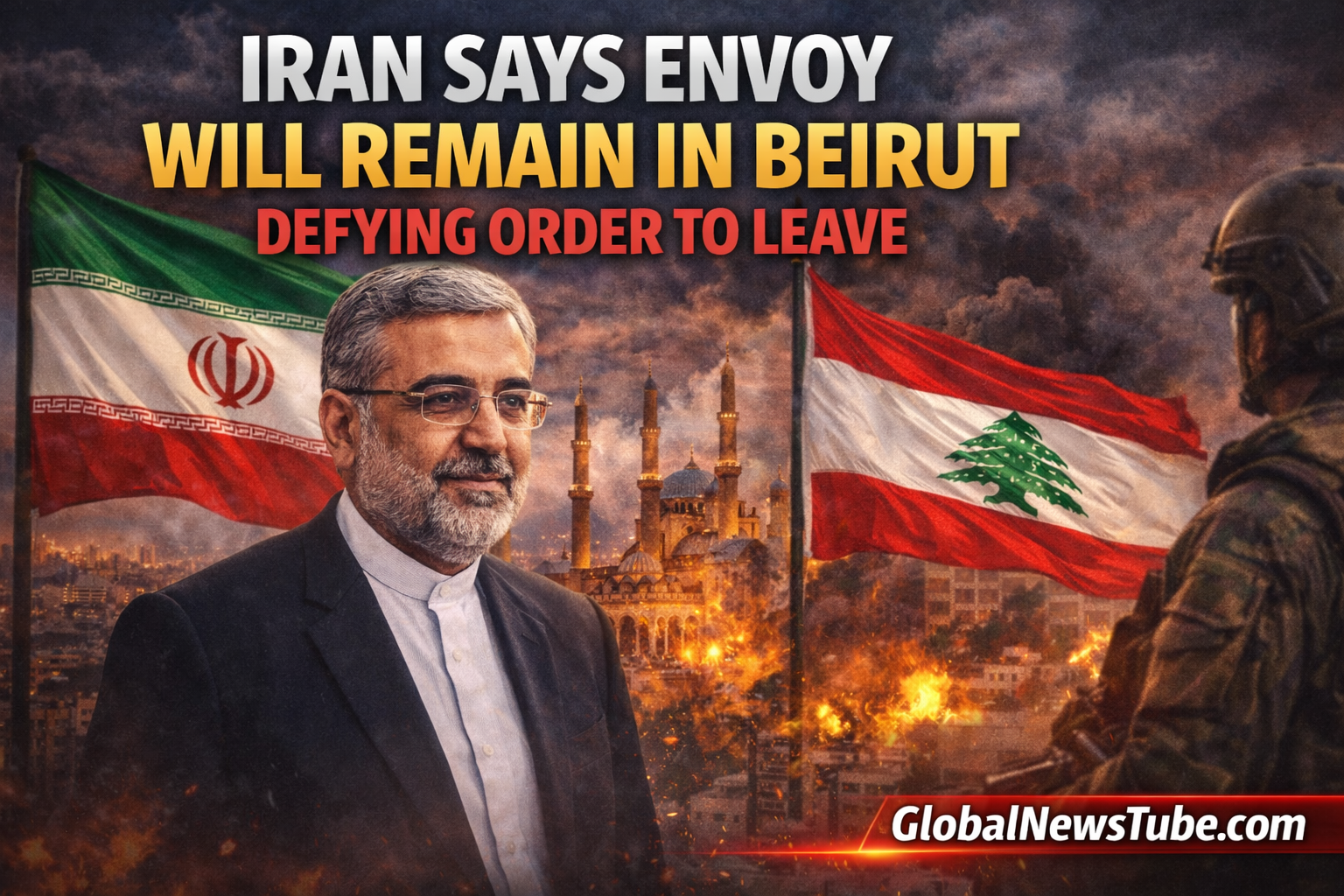
The announcement that Iran says its envoy will remain in Beirut despite an official order to leave marks a major escalation in Middle East tensions. The decision highlights the growing divide between Lebanon’s government and Iran, while also reflecting the broader geopolitical struggle involving regional powers and ongoing conflict. As tensions intensify, the situation underscores how diplomatic norms are increasingly being challenged in a volatile environment shaped by war, alliances, and political influence.
Lebanon Orders Iranian Envoy to Leave
Lebanon’s government recently declared the Iranian ambassador persona non grata and ordered him to leave the country by a set deadline. The move was based on accusations that the envoy had interfered in Lebanon’s internal political affairs, violating diplomatic norms and international protocols. Lebanese officials framed the decision as part of a broader effort to reassert state sovereignty and reduce foreign influence within the country.
The expulsion order also reflects internal political pressure within Lebanon, where leaders are trying to demonstrate control amid growing instability. By taking action against the Iranian envoy, Lebanon aimed to send a clear message that external interference would not be tolerated, especially during a period of conflict and national crisis.
Iran Defies the Expulsion Order
Despite Lebanon’s directive, Iran has made it clear that its envoy will remain in Beirut. Iranian officials have insisted that the ambassador will continue performing his duties, effectively rejecting Lebanon’s authority on the matter. This defiance has created a diplomatic standoff, raising questions about Lebanon’s ability to enforce its decisions and maintain sovereignty.
The fact that Iran says its envoy will remain in Beirut highlights Tehran’s strategic priorities in the region. It signals that Iran is unwilling to reduce its influence in Lebanon, particularly at a time when regional tensions are high and alliances are being tested.
Hezbollah’s Role in the Crisis
A key factor in this situation is the influence of Hezbollah, the Iran backed group that holds significant political and military power in Lebanon. Hezbollah has openly opposed the Lebanese government’s decision to expel the Iranian envoy, reinforcing its alignment with Tehran.
The group’s involvement complicates the situation further, as it operates with considerable autonomy and has been actively engaged in regional conflict. Hezbollah’s actions have drawn Lebanon deeper into ongoing tensions with Israel, contributing to a broader crisis that has already resulted in significant casualties and displacement.
The support of Hezbollah and its allies for the Iranian envoy has made it difficult for the Lebanese government to enforce its expulsion order, exposing divisions within the country’s political system.
Rising Regional Tensions
The decision that Iran says its envoy will remain in Beirut comes amid escalating conflict across the Middle East. Fighting between Israel and Hezbollah has intensified, drawing in multiple regional actors and increasing the risk of a wider war. The conflict has already led to thousands of casualties and the displacement of large numbers of civilians.
At the same time, tensions involving the United States, Iran, and other regional powers continue to rise, further complicating the situation. Military operations, diplomatic disputes, and economic pressures are all contributing to an increasingly unstable environment.
In this context, the dispute over the Iranian envoy is not an isolated incident but part of a broader geopolitical struggle that is reshaping the region.
Impact on Lebanon’s Sovereignty
The standoff raises serious concerns about Lebanon’s sovereignty and its ability to enforce government decisions. When a foreign envoy refuses to comply with an expulsion order, it challenges the authority of the host country and sets a potentially dangerous precedent.
Critics argue that the situation demonstrates the extent of Iran’s influence in Lebanon, particularly through its support for Hezbollah. Some regional leaders have even suggested that Iran effectively holds significant sway over Lebanese political dynamics, further undermining state authority.
For Lebanon, the crisis highlights the difficulty of maintaining independence and stability in a region where powerful external actors are deeply involved in domestic affairs.
Diplomatic and Political Implications
The refusal to leave Beirut could have significant diplomatic consequences. It may strain relations between Iran and Lebanon, while also drawing international attention to the broader issue of foreign influence in the country.
The situation could also complicate ongoing efforts to de escalate tensions in the region. Diplomatic negotiations often rely on adherence to international norms, and violations of these norms can make dialogue more difficult.
Additionally, the incident may influence how other countries approach their diplomatic relations with both Iran and Lebanon, potentially leading to shifts in alliances and strategies.
Future Outlook
Looking ahead, several scenarios could unfold. Lebanon may attempt to enforce the expulsion order more aggressively, though this could risk internal conflict given Hezbollah’s opposition. Alternatively, the government may choose to avoid confrontation, allowing the situation to remain unresolved.
Iran, on the other hand, is likely to maintain its position, viewing its presence in Lebanon as strategically essential. The ongoing conflict in the region means that Tehran has strong incentives to retain influence and support its allies.
There is also the possibility that international mediation could play a role in resolving the dispute, although the broader geopolitical tensions may limit the effectiveness of such efforts.
The development that Iran says its envoy will remain in Beirut despite an expulsion order reflects the complex and often volatile nature of Middle East politics. It highlights the intersection of diplomacy, conflict, and regional power dynamics, while also raising important questions about sovereignty and international norms.
As the situation continues to evolve, the standoff serves as a reminder of how deeply interconnected regional conflicts have become. Whether this dispute escalates or is resolved peacefully will depend on a range of factors, including political decisions within Lebanon, Iran’s strategic priorities, and the broader trajectory of tensions in the region.