


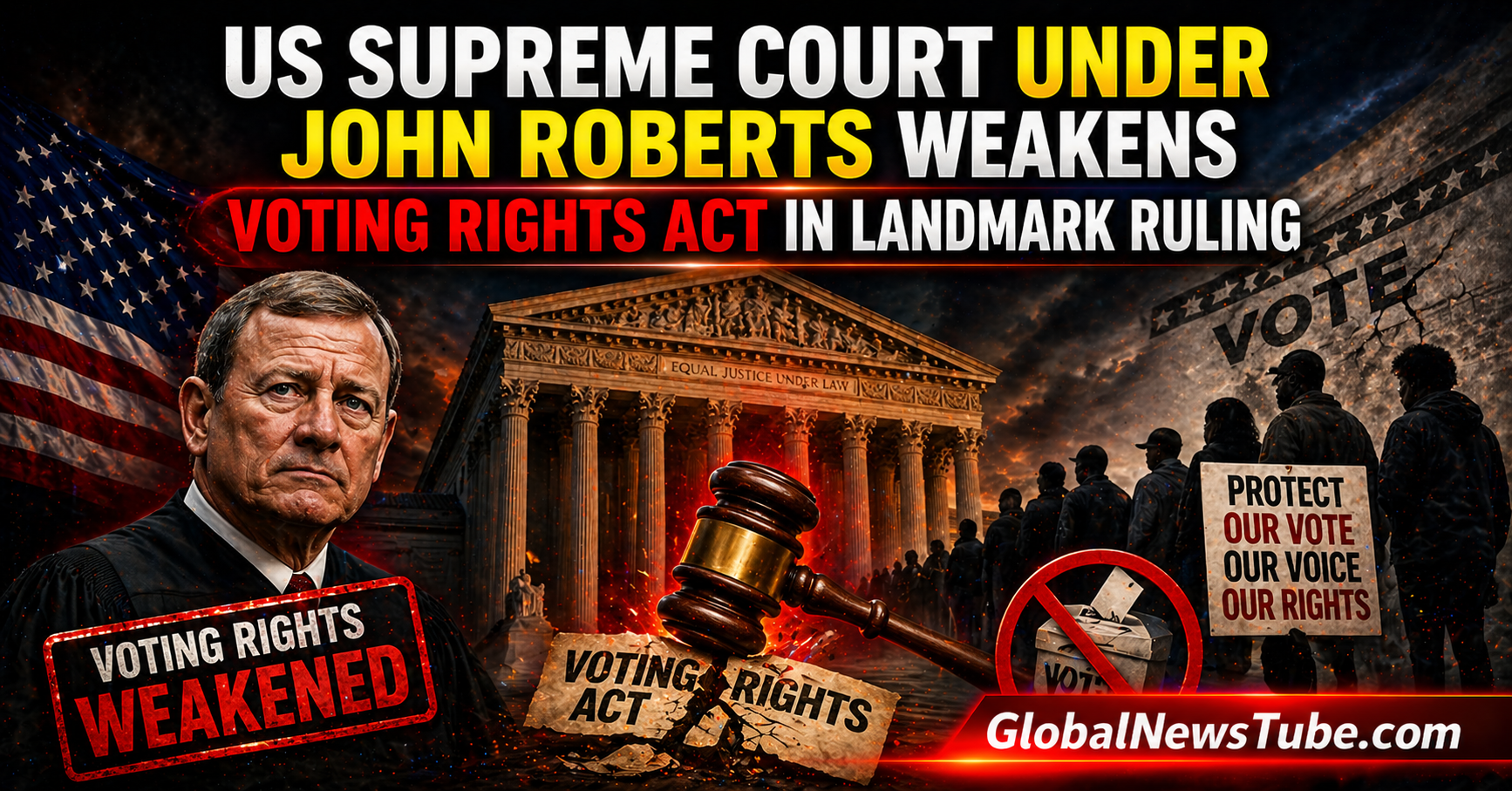
The United States is witnessing a major shift in its legal and political landscape after the U.S. Supreme Court issued a landmark ruling that significantly weakens key protections under the Voting Rights Act of 1965. Led by Chief Justice John Roberts, the court’s conservative majority delivered a decision that could reshape how elections are conducted and how minority voting rights are protected. The ruling comes at a crucial time, with political tensions rising and debates over democracy intensifying across the country.
Landmark Supreme Court Decision
The recent decision by the U.S. Supreme Court marks a turning point in the interpretation of voting rights law. In a 6-3 ruling, the court curtailed the power of Section 2 of the Voting Rights Act of 1965, which had long been used to challenge electoral maps that diluted minority voting strength.
The decision requires plaintiffs to prove intentional discrimination rather than relying on outcomes that disproportionately affect minority voters. This change significantly raises the legal bar for challenging voting laws and electoral district maps.
Background of the Voting Rights Act
The Voting Rights Act of 1965 is widely regarded as one of the most important achievements of the civil rights movement in the United States. It was enacted to eliminate racial discrimination in voting, particularly in states where minority voters faced systemic barriers.
Key provisions of the law included Section 2, which prohibits discriminatory voting practices, and Section 5, which required certain states to obtain federal approval before making changes to election laws. Over time, however, these protections have been weakened through judicial decisions.
A Pattern of Judicial Changes
The latest ruling is part of a broader trend under John Roberts. In 2013, the U.S. Supreme Court struck down a key provision of the Voting Rights Act, effectively ending federal oversight of election law changes in certain states.
Subsequent rulings have continued to narrow the scope of voting rights protections, limiting the ability of courts and individuals to challenge discriminatory practices. Legal experts argue that these decisions have gradually weakened the law’s effectiveness.
The Louisiana Redistricting Case
The current decision stems from a dispute over congressional district maps in the state of Louisiana. Lower courts had required the state to create a second majority Black district to ensure fair representation under the Voting Rights Act.
However, the U.S. Supreme Court ruled against this requirement, stating that the use of race in drawing district boundaries must be limited. This decision restricts how race can be considered in redistricting, even when the goal is to improve minority representation.
Impact on Minority Voting Rights
The ruling has raised serious concerns about the future of minority voting rights in the United States. By requiring proof of intentional discrimination, the court has made it more difficult to challenge laws and maps that have discriminatory effects but lack explicit intent.
Critics argue that this change could reduce the number of majority minority districts and weaken the political influence of minority communities. Supporters, however, believe the ruling ensures equal treatment under the law by limiting race-based decision-making.
Political Implications
The decision is expected to have significant political consequences, particularly in upcoming elections. Lawmakers may use the ruling to redraw district maps, potentially altering the balance of power in Congress and state legislatures.
The issue is likely to become a major topic in political debates, with different parties offering contrasting views on voting rights, fairness, and representation. The ruling could also influence voter turnout and public trust in the electoral process.
Debate Over Constitutional Principles
Supporters of the ruling argue that it aligns with a color-blind interpretation of the Constitution, where race should not play a role in government decisions. They believe this approach promotes fairness and equality.
Critics, however, argue that ignoring race in a society with a history of discrimination can perpetuate inequality. They contend that the Voting Rights Act was specifically designed to address systemic disparities and that weakening its provisions undermines its original purpose.
Legal and Constitutional Arguments
The decision is based on interpretations of the Equal Protection Clause of the 14th Amendment. The majority opinion suggests that race conscious redistricting may violate constitutional principles, even when intended to correct historical injustices.
This interpretation represents a shift from earlier rulings that allowed race to be considered as a factor in ensuring fair representation. Legal experts believe the decision could reshape how courts handle voting rights cases in the future.
Economic and Social Impact
The implications of the ruling extend beyond politics. Voting rights are closely connected to public policy decisions that affect education, healthcare, and economic opportunities. Reduced minority representation could influence how resources are allocated in different communities.
The decision may also deepen social divisions, as debates over race, equality, and democracy continue to intensify across the country.
Reaction From Civil Rights Groups
Civil rights organizations have strongly criticized the ruling, calling it a setback for democracy and equality. Many groups argue that the decision weakens protections that were achieved through decades of activism and legal reform.
Advocates are calling for legislative action to restore and strengthen voting rights protections, emphasizing the need for updated laws that reflect current challenges.
Future of Voting Rights Legislation
In response to the ruling, lawmakers may attempt to introduce new legislation aimed at restoring key protections of the Voting Rights Act. Proposed measures include updated federal oversight and clearer standards for identifying discrimination.
However, passing such legislation may be difficult in a politically divided environment, leaving the future of voting rights uncertain.
Long-Term Outlook
The long-term impact of the decision could be significant. By raising the standard for proving discrimination and limiting the role of race in redistricting, the ruling may reshape the electoral landscape for years to come.
States are likely to revise district maps under the new legal framework, potentially leading to changes in political representation. Legal challenges are expected to continue as courts interpret the implications of the ruling.
The ruling by the U.S. Supreme Court under Chief Justice John Roberts represents a pivotal moment in the history of the Voting Rights Act of 1965. By weakening key protections and raising the bar for discrimination claims, the court has fundamentally altered the legal framework governing voting rights in the United States.
While supporters argue that the decision promotes constitutional fairness, critics warn that it could erode longstanding civil rights protections. As debates continue and new legal challenges emerge, the future of voting rights in the United States remains uncertain, with far-reaching implications for democracy and representation.