


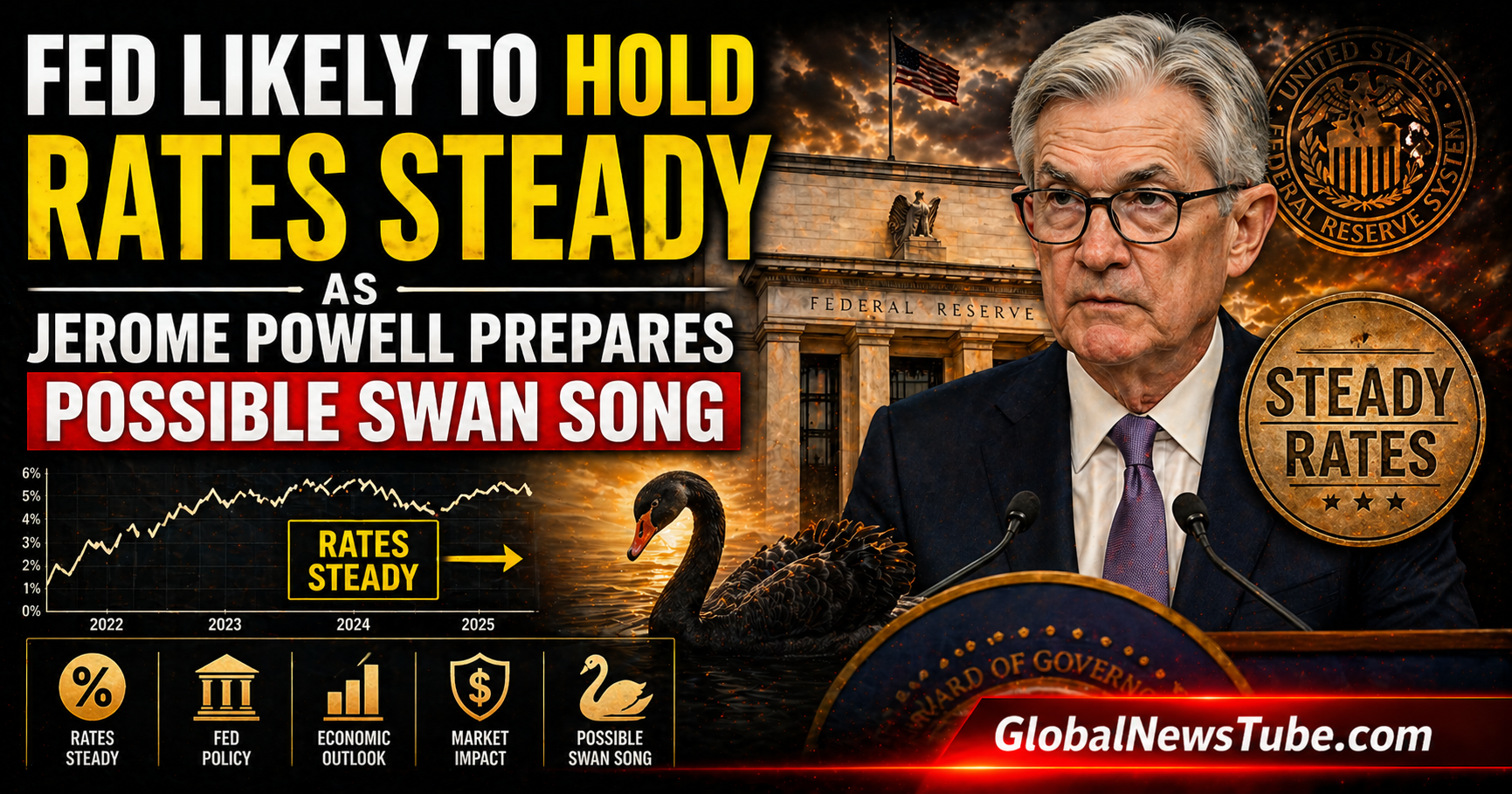
The United States Federal Reserve is expected to keep interest rates unchanged, reflecting a cautious approach to an uncertain economic environment. As Jerome Powell prepares for what may be his final policy phase, the focus has shifted toward the broader implications of monetary policy. The development that Fed likely hold rates steady comes amid inflation concerns, global instability, and anticipation of leadership transition at the central bank.
Current Fed Policy and Interest Rate Outlook
The Federal Reserve is widely expected to maintain its benchmark interest rate within the current range. This decision reflects a wait and see strategy as policymakers evaluate the effects of earlier rate adjustments.
Holding rates steady allows the Fed to monitor inflation trends and economic performance without introducing additional volatility. It also signals confidence that existing policies are still influencing economic conditions effectively.
This approach aligns with the central bank’s broader goal of maintaining stability while avoiding abrupt policy changes that could disrupt financial markets.
Inflation Pressures and Economic Challenges
Persistent inflation remains one of the biggest challenges facing the Federal Reserve. Rising energy costs and supply chain disruptions have contributed to higher consumer prices, placing pressure on households and businesses.
Traditionally, high inflation would prompt interest rate increases. However, aggressive tightening can slow economic growth and raise borrowing costs, creating a delicate balancing act for policymakers.
By choosing to hold rates steady, the Fed is attempting to manage inflation without triggering a downturn. This cautious stance reflects the complexity of the current economic environment.
Labor Market and Growth Outlook
The labor market continues to play a critical role in shaping monetary policy. While employment levels remain relatively stable, there are signs of slowing job growth and economic uncertainty.
A strong labor market supports consumer spending, which drives economic growth. However, any weakening in employment could reduce demand and impact overall economic performance.
Maintaining stable interest rates helps preserve balance in the labor market, allowing the Fed to respond flexibly if conditions change.
Jerome Powell’s Leadership and Possible Exit
The current phase of monetary policy is particularly significant as Jerome Powell approaches a potential transition. His leadership has been marked by efforts to manage inflation while sustaining economic growth during challenging times.
Powell’s tenure has involved navigating complex issues, including global economic shocks and domestic financial pressures. His approach has emphasized caution, adaptability, and clear communication.
As speculation grows about his future role, markets are closely watching for signals that may indicate the direction of future policy under new leadership.
Transition to New Leadership
The possibility of new leadership at the Federal Reserve introduces additional uncertainty. A new chair could bring different priorities or strategies, potentially influencing how the Fed addresses inflation and economic growth.
This transition period is crucial, as it may shape the long-term direction of US monetary policy. Stability during this phase will be essential to maintaining confidence in financial markets.
Market Expectations and Investor Sentiment
Investors are closely monitoring the Fed’s decisions and statements. The expectation that the Fed likely hold rates steady has largely been priced into financial markets, contributing to relative stability in stocks and bonds.
However, uncertainty remains about future policy moves. Markets are sensitive to any indication of rate changes, and even small shifts in communication can influence investor behavior.
Confidence in the Fed’s approach plays a key role in maintaining market stability during periods of economic uncertainty.
Impact of Global Events on Fed Policy
Global developments continue to influence US monetary policy. Geopolitical tensions, particularly in energy producing regions, have contributed to fluctuations in oil prices and overall inflation.
These external factors complicate the Fed decision making process. Policymakers must consider not only domestic conditions but also international events that can impact the US economy.
The interconnected nature of global markets means that decisions made by the Federal Reserve have far reaching consequences.
Risks and Policy Challenges Ahead
The Federal Reserve faces several key challenges moving forward. Persistent inflation, potential economic slowdown, and leadership transition all contribute to uncertainty.
Maintaining credibility is also critical. The Fed must balance political pressures while ensuring that its decisions are based on economic data and long term objectives.
Effective communication will be essential in guiding expectations and minimizing market volatility.
Future Outlook for Interest Rates
While the immediate outlook suggests stable rates, future decisions will depend on economic conditions. If inflation continues to rise, the Fed may consider tightening policy. Conversely, if growth weakens, rate cuts could become necessary.
The path forward will require flexibility and careful analysis of incoming data. Policymakers will need to adapt quickly to changing conditions to maintain economic stability.
Broader Implications for the US Economy
The decision to hold rates steady has significant implications for the broader economy. Interest rates influence borrowing costs, investment decisions, and consumer spending.
Stable rates provide predictability for businesses and households, helping to support economic activity. However, prolonged uncertainty could still affect long-term planning and growth.
The Fed’s actions will continue to play a central role in shaping economic outcomes in the months ahead.
The expectation that the Fed likely hold rates steady reflects a cautious response to a complex economic landscape. With inflation pressures, global uncertainties, and leadership changes all in play, the Federal Reserve faces a challenging environment.
As Jerome Powell approaches a potential transition, his decisions carry significant weight. The direction taken during this period will influence not only short-term economic stability but also the long-term trajectory of US monetary policy.
In an era of uncertainty, the Fed’s focus on stability and measured decision-making remains essential for maintaining confidence in the economy.