


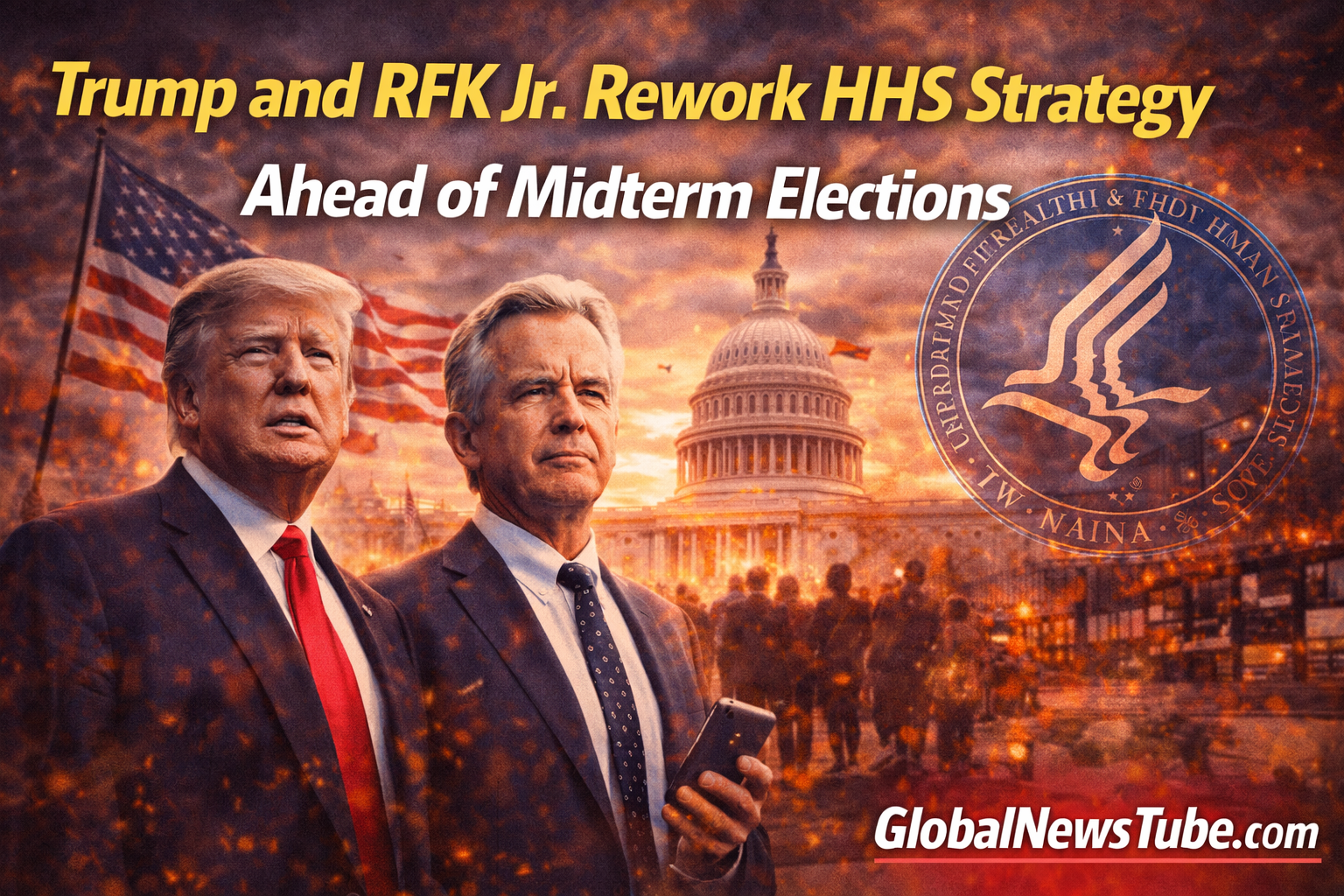
Trump and RFK Jr. Rework HHS Strategy Ahead of Midterm Elections
The relationship between President Donald Trump and Health and Human Services Secretary Robert F. Kennedy Jr. has entered a more politically sensitive phase as the administration looks ahead to the 2026 midterm elections. Recent reporting indicates that the White House has tightened its control over HHS after internal frustration over messaging, staffing conflicts, and controversy surrounding Kennedy’s Make America Healthy Again agenda. The shift suggests that while Kennedy remains a valuable political figure for parts of Trump’s coalition, the administration is increasingly focused on making sure his department supports broader electoral goals rather than creating new liabilities.
The central issue is not whether Kennedy still matters inside the administration. He clearly does. The issue is how much freedom he will have to shape health policy and public messaging on his own. Reports suggest the White House moved to install stronger oversight at HHS after concerns over unpopular vaccine messaging and operational setbacks. A Trump ally in a powerful deputy role signals a clear effort to bring the department more tightly in line with White House political priorities.
Why the Trump RFK Jr HHS Midterm Elections Story Matters
The reason the Trump RFK Jr HHS midterm elections story matters is that HHS has become both a policy arena and a political testing ground. Trump and his allies appear to believe that parts of Kennedy’s Make America Healthy Again, or MAHA, message can help Republicans connect with voters who are skeptical of institutions, concerned about chronic disease, and frustrated with the public health establishment. At the same time, that same message can become politically risky when it overlaps with vaccine controversy or creates the impression of administrative instability.
That tension helps explain the current recalibration. The political goal appears to be preserving the parts of Kennedy’s agenda that test well with voters while reducing the chance that his more controversial instincts become a burden in competitive races.
White House Tightens Control Over HHS
The reported White House HHS shake up is significant because it shows this is not just a messaging adjustment. It is also a structural one. Several officials appear to have been pushed aside or lost influence, while White House approved messaging became more dominant. The move seems designed to reduce infighting, improve discipline, and make sure HHS is aligned with the administration’s most electorally useful priorities, especially drug pricing and food related policy.
This matters because HHS is one of the most visible departments in government. Its decisions affect vaccines, disease response, food policy, Medicare, drug prices, and public health agencies. Any turbulence inside the department can quickly become a political story, especially in an election year. When a president is trying to defend congressional majorities, even internal staffing decisions can carry broader strategic meaning.
The reorganization appears to reflect a compromise. Kennedy keeps his public profile and political value, but with reduced independence. That allows the administration to preserve his brand and grassroots appeal while placing more of the department’s operational machinery under trusted management.
RFK Jr HHS Midterm Elections and the MAHA Strategy
The broader RFK Jr HHS midterm elections calculation appears to rest on whether MAHA can be turned into a disciplined political asset. Kennedy’s supporters see him as a figure who can energize voters around food quality, chronic illness, government transparency, and distrust of entrenched health bureaucracies. Those themes may resonate with parts of the Republican base and with some independents who feel alienated from traditional public institutions.
But the risk is equally clear. Kennedy’s long record of vaccine skepticism and confrontational rhetoric gives critics an easy line of attack. If Republican candidates are forced to defend unpopular public health positions or explain controversial HHS decisions, the political value of Kennedy’s movement could weaken quickly. That is why the White House seems to be trying to separate the politically useful parts of MAHA from the parts most likely to create backlash.
In effect, the administration appears to be making a midterm bet health policy can help mobilize and persuade voters, but only if it is framed around affordability, food, and institutional reform rather than polarizing scientific disputes.
What the Shake Up Says About Trump’s Governing Style
The evolving Trump health policy midterms strategy also reflects a familiar pattern in Trump’s governing style. He often empowers big personalities who energize his coalition, then moves to impose tighter control when those figures generate too much political risk. Kennedy fits that pattern. He brings a distinctive movement, strong media attention, and outsider appeal. But when his department begins producing headlines that could complicate the midterm map, the White House responds by tightening the leash rather than removing him outright.
This approach allows Trump to preserve flexibility. He can still claim Kennedy’s populist energy and outsider credibility while signaling to donors, candidates, and swing voters that the administration is serious about discipline and results. The strengthening of White House aligned leadership inside HHS reinforces that balance between political experimentation and centralized control.
What Happens Next
The success of this strategy will depend on whether HHS can avoid further controversy and produce politically useful wins in the months ahead. Drug pricing efforts, food related initiatives, and visible action on consumer health issues may all be used as evidence that the department is delivering results voters can understand. At the same time, any renewed turmoil around vaccines, outbreak response, or agency instability could undermine that message quickly.
The midterms will therefore test not just Kennedy’s standing, but the administration’s ability to manage him. If the White House can harness the MAHA movement without absorbing its most divisive baggage, HHS could become part of a broader Republican argument about reform and responsiveness. If not, Democrats will likely turn Kennedy into a symbol of overreach, disorder, and risky governance.
Conclusion
The Trump RFK Jr HHS midterm elections story is really about political calibration. Trump still sees value in Kennedy, but the White House now appears determined to control the message, narrow the risks, and make HHS serve the electoral needs of 2026 more directly. That means tighter supervision, more disciplined priorities, and less room for freelance controversy.
In that sense, the HHS shake up is bigger than one department. It shows how the administration is trying to turn a volatile movement into a midterm advantage without letting it become a political liability.