


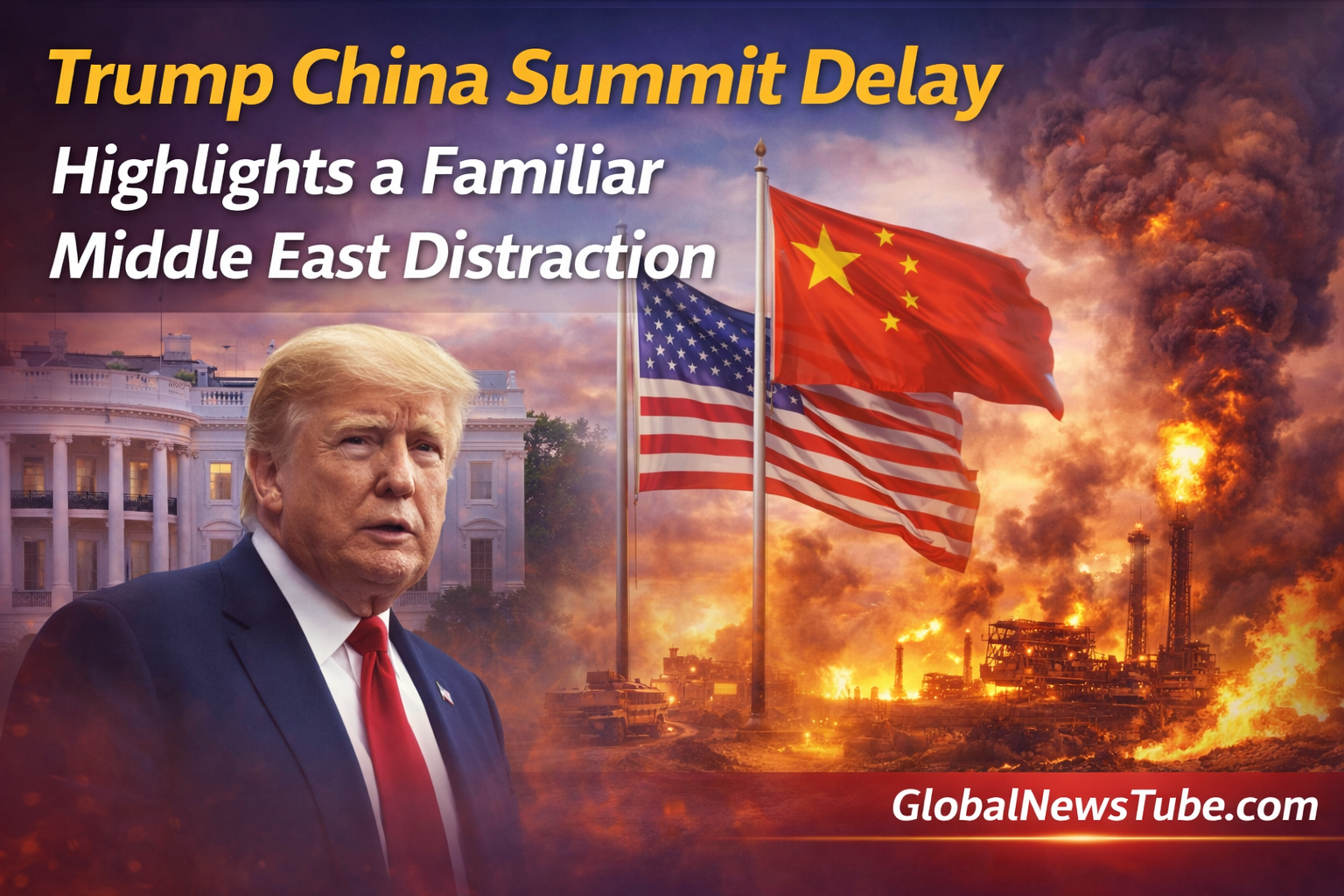
The Trump China summit delay is more than a simple change in scheduling. It reflects a deeper pattern in American foreign policy, where long term strategic plans involving China are often interrupted by sudden crises in the Middle East. President Donald Trump’s postponed meeting with Chinese President Xi Jinping shows how quickly Washington’s diplomatic priorities can shift when conflict, oil security, and military tensions rise in another part of the world.
The delayed summit had been expected to support a fragile trade truce and open the door for renewed high level engagement between the United States and China. Instead, renewed instability in the Middle East appears to have pushed that diplomatic effort into the background. This development is significant because it highlights the challenge of balancing immediate geopolitical emergencies with broader long term strategy.
Why the Trump China Summit Delay Matters
The Trump China summit delay matters because US China relations remain one of the most important forces shaping the global economy and international politics. Any major meeting between Trump and Xi carries weight, especially at a time when trade tensions, technology rivalry, and strategic competition continue to influence both countries.
A summit between the two leaders was expected to create momentum for dialogue. It could have helped ease economic pressure, reduce political uncertainty, and clarify where both sides stand on major issues. When such a summit is postponed, it sends a signal that other global events have become more urgent than even one of the world’s most important bilateral relationships.
This delay also affects perceptions. Allies, investors, and policymakers all watch these diplomatic signals carefully. A postponed summit can raise questions about US priorities and whether the administration can stay focused on China while also managing instability elsewhere.
The Middle East Distraction Returns
One of the most striking aspects of this situation is the return of a familiar Middle East distraction. For years, US officials have said that China is America main long term strategic competitor. Yet again and again, crises in the Middle East demand immediate action and push Asia focused policy into second place.
This is not a new pattern. Several US administrations have tried to shift more attention toward the Indo Pacific region, only to find themselves pulled back into Middle Eastern conflicts, energy concerns, and regional security challenges. The current delay shows that this pattern remains very much alive.
For Trump, the distraction appears tied to the growing pressure surrounding conflict involving Iran and the wider regional threat to shipping and energy markets. These developments carry serious consequences for oil prices, global trade, and US domestic politics, making them difficult to ignore.
How the Middle East Crisis Affects US China Relations
The relationship between Washington and Beijing does not operate in isolation. A crisis in the Middle East can directly influence how the United States approaches China. In this case, the administration’s attention has shifted toward urgent security concerns, leaving less room for careful summit planning and strategic diplomacy.
This matters because US-China engagement requires preparation, consistency, and clear objectives. A summit is not just a ceremonial meeting. It usually involves months of negotiations, agenda-setting, and diplomatic groundwork. When attention suddenly shifts elsewhere, it becomes harder to maintain momentum.
At the same time, China is also affected by instability in the Middle East. Beijing depends heavily on global trade routes and energy imports, so disruptions in critical shipping lanes create economic risks for China as well. However, China and the United States often respond differently to these crises, which can make coordination more difficult.
Strategic Competition Versus Immediate Crisis
The delayed summit highlights a central problem in US foreign policy the tension between long term competition and short term emergencies. China represents a major strategic challenge in trade, technology, defense, and diplomacy. But the Middle East still has the power to demand urgent military, political, and economic attention.
This creates a strategic imbalance. Policymakers may know that China deserves sustained focus, yet real time events force them to redirect energy elsewhere. As a result, long term planning becomes vulnerable to sudden disruption.
In Trump case, postponing the summit may have been unavoidable given the circumstances. Still, it underscores how difficult it is for any US president to maintain a consistent China strategy while dealing with unpredictable crises abroad.
Economic Risks Behind the Delay
Another important reason for the summit delay is the economic threat linked to Middle East instability. When tensions rise near key oil shipping routes, global markets react quickly. Energy prices can jump, business confidence can weaken, and governments are forced to respond to the risk of wider disruption.
For the United States, these economic pressures are politically sensitive. Rising fuel prices and supply chain instability can have direct effects on consumers and markets. That makes the Middle East crisis not only a foreign policy issue but also a domestic political concern.
This economic pressure may explain why the administration chose to shift focus away from the China summit, at least temporarily. Even though China remains a core strategic issue, immediate economic risks often carry more urgency in the short term.
What This Means for Trump and Xi
The postponed meeting creates uncertainty for both leaders. For Trump, it may raise concerns about whether his administration can show steady leadership on China. For Xi, the delay may be viewed as a sign that Washington is once again distracted by a separate regional conflict.
At the same time, the postponement could offer both sides more time to prepare. If tensions in the Middle East ease, a later summit might be more productive and better structured. Additional time could allow negotiators to build a clearer agenda and reduce the risk of a poorly timed meeting.
Still, diplomacy depends heavily on momentum. Delays can weaken confidence, alter expectations, and create new obstacles. That is why the timing of this summit matters as much as the meeting itself.
A Familiar Pattern in American Foreign Policy
This episode fits a broader historical pattern. The United States has repeatedly tried to rebalance its foreign policy toward Asia, only to be drawn back into Middle East crises. Whether the issue is war, terrorism, oil security, or regional alliances, the Middle East continues to shape Washington’s agenda in powerful ways.
That does not mean China becomes less important. In fact, China may remain the defining long term competitor for the United States. But the reality is that immediate crises often outrank strategic theory. Presidents may plan for one geopolitical future while being forced to react to another.
The delay of the Trump Xi summit is a strong example of that contradiction. It shows the gap between stated priorities and operational reality.
Conclusion
The Trump China summit delay is not just a diplomatic scheduling change. It reveals how fragile long term strategy can become when urgent Middle East tensions demand immediate attention. While Washington continues to frame China as its main strategic rival, real world events show that the Middle East still has the power to dominate US decision making.
This delay also sends a broader message about the difficulty of managing multiple global priorities at once. The United States wants to stay focused on China, but repeated disruptions make that goal harder to achieve. Until Washington finds a more effective way to manage both strategic competition and regional emergencies, this kind of postponement is likely to happen again.