


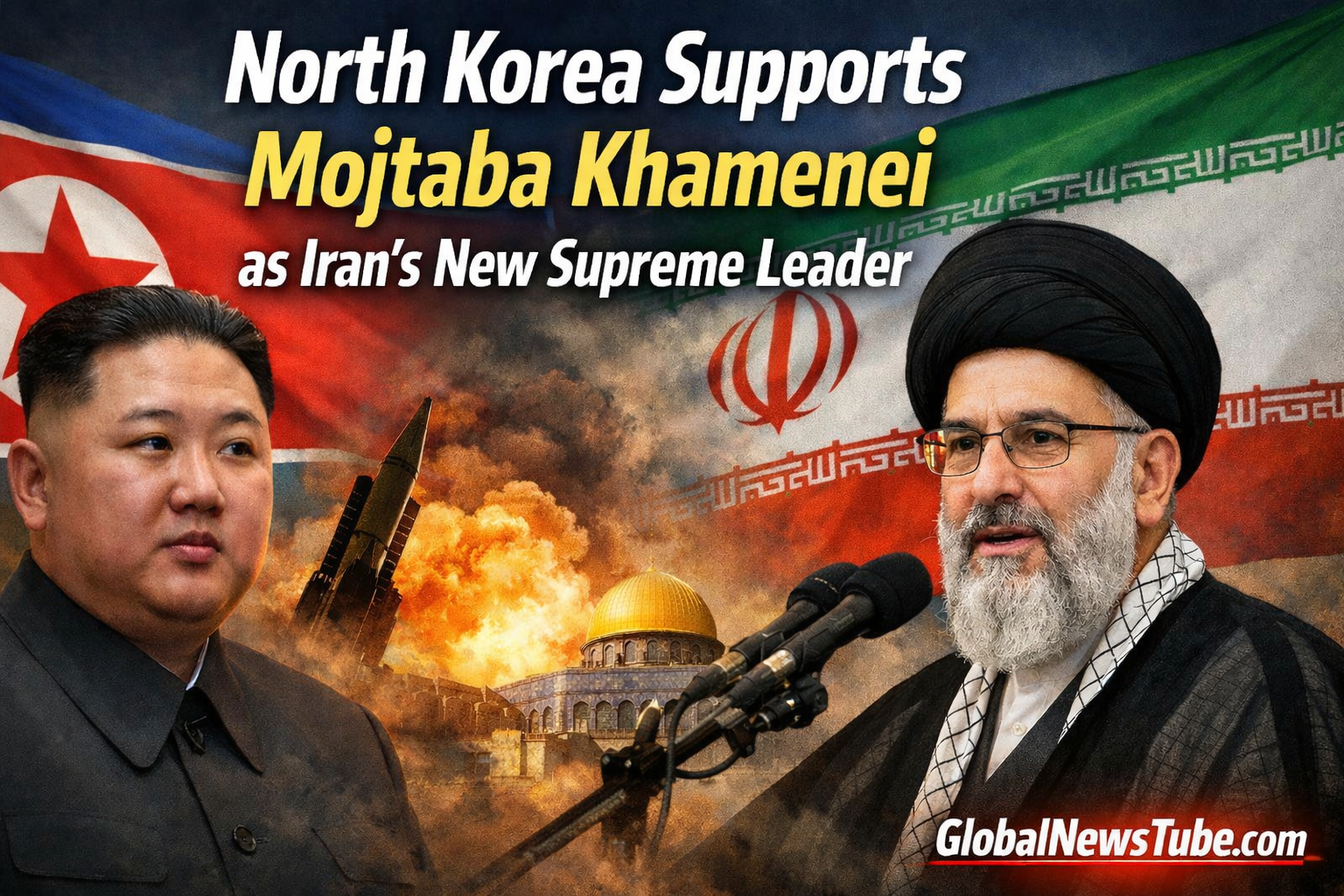
North Korea Supports Mojtaba Khamenei as Iran’s New Supreme Leader
North Korea has publicly voiced support for Iran’s decision to appoint Mojtaba Khamenei as the new supreme leader, adding another major dimension to an already tense geopolitical moment. The statement, carried by North Korea’s state media, signals Pyongyang’s backing of Tehran at a time when the Middle East is facing deep uncertainty, rising military pressure, and growing diplomatic consequences. This reaction has quickly drawn attention because it connects two states often viewed through the lens of international confrontation, sanctions, and resistance to Western influence.
The headline North Korea supports Mojtaba Khamenei is more than a simple diplomatic gesture. It reflects a broader strategic message. At a time when Iran is going through one of the most sensitive leadership transitions in its modern history, North Korea has chosen not to remain neutral. Instead, it has openly recognized Iran’s decision and used the moment to strengthen its own political position against the United States and its allies. For global observers, that makes this development significant beyond the symbolic level.
When North Korea supports Mojtaba Khamenei, it immediately becomes a story with regional and international implications. Iran’s supreme leader is not just a ceremonial figure. The role represents the highest political and religious authority in the country, with control over major state institutions, military influence, and final authority on many strategic matters. As a result, any foreign reaction to the appointment of a new supreme leader is likely to be interpreted as a statement on legitimacy, alignment, and future diplomatic direction.
Why North Korea Supports Mojtaba Khamenei Matters
North Korea’s support matters because it comes from a government that has long challenged US foreign policy and openly opposed the influence of Washington in global affairs. By backing Iran’s leadership decision, Pyongyang is reinforcing a message of solidarity with states that are in conflict with the West. This is not only about Iran’s internal political transition. It is also about how North Korea wants the international community to read its position in relation to wider global tensions.
For Iran, public support from another anti Western state can help project continuity during a highly sensitive moment. Leadership changes at the highest level often invite uncertainty, speculation, and pressure. In such circumstances, even symbolic diplomatic recognition can carry strategic value. It sends a message that Iran is not isolated and that there are governments willing to publicly stand behind its decisions.
Mojtaba Khamenei Supreme Leader Transition and Its Importance
The rise of Mojtaba Khamenei as supreme leader marks a major moment in Iran’s political history. Any change in leadership at this level has immediate consequences not only for domestic power structures but also for regional policy, security calculations, and diplomatic relations. Iran’s supreme leader plays a direct role in shaping the country’s military doctrine, foreign affairs direction, and ideological posture. That means a new supreme leader is always a matter of global interest.
The appointment of Mojtaba Khamenei has generated intense discussion because of both timing and symbolism. Iran’s leadership transition has unfolded during a period of conflict and instability rather than in a calm political environment. That alone makes the story more significant. A transfer of authority during wartime or heightened regional tensions tends to reshape how outside states respond, and it often influences how quickly new alliances or public statements emerge.
The latest statement has renewed interest in North Korea Iran relations, a topic that often resurfaces during periods of international crisis. While the two countries are very different in terms of geography, governance style, and domestic political systems, they are often mentioned together in discussions about sanctions, deterrence, regional tension, and opposition to Western pressure.
When North Korea publicly supports Iran’s leadership choice, it feeds directly into this larger narrative. It suggests that Pyongyang wants its voice to be heard not just as a distant observer, but as a state willing to take a clear position. The message also reinforces the idea that political symbolism matters greatly during moments of conflict. Even when no military alliance is formally declared, public endorsement can still carry diplomatic meaning.
This is why North Korea supports Mojtaba Khamenei is an important headline for international observers. It shows that Pyongyang sees value in aligning itself with Tehran at a time of uncertainty. That alignment may be rhetorical, strategic, or ideological, but in all cases it adds weight to the broader discussion around shifting power balances in the region.
A Leadership Change During a Time of Conflict
One of the most important elements of this story is timing. The transition involving Mojtaba Khamenei as supreme leader did not happen during a period of ordinary domestic politics. It unfolded amid conflict, military fears, and rising regional anxiety. Leadership changes are always delicate, but they become even more sensitive when they occur under pressure.
In such moments, every statement from other countries carries added importance. North Korea’s endorsement may not immediately alter the facts on the ground, but it shapes the political narrative surrounding the event. It frames Iran’s leadership change as something recognized and respected by at least some governments beyond its borders. That can influence public perception, diplomatic discussions, and strategic messaging.
At the same time, it highlights how global politics now function in a highly interconnected way. A leadership decision in Tehran can trigger public messaging from Pyongyang, concern in Washington, debate in Europe, and analysis across the Middle East. That interconnected reaction is what gives the story lasting significance.
Strategic and Symbolic Implications
There are two major ways to read this development strategic and symbolic. Strategically, North Korea’s position may be seen as part of a broader pattern in which governments under Western sanctions or pressure seek to reinforce one another politically. Even if practical cooperation remains unclear, public support itself has value. It communicates resistance, solidarity, and defiance.
Symbolically, the statement is powerful because it arrives during a moment of uncertainty. When North Korea supports Mojtaba Khamenei, it is effectively saying that Iran’s leadership transition deserves recognition rather than doubt. That matters because legitimacy is often one of the first battlegrounds during any major transfer of power.
This also gives extra relevance to the keyword Iran leadership change. The story is not only about a new individual entering a top office. It is about how that change is being received abroad, how it is being framed politically, and how it could influence future regional dynamics.
Global Reaction and Future Questions
The international impact of this moment lies in what it may signal next. Public backing from North Korea could deepen concerns among Western policymakers about the visibility of anti Western alignment. For Iran, however, such support may be useful in showing continuity and foreign recognition during a difficult transition.
Going forward, attention will remain fixed on whether this support remains rhetorical or evolves into something more meaningful in diplomatic or strategic terms. Analysts will also watch how Iran’s new leadership defines itself and whether global responses shift as Mojtaba Khamenei settles into the role.
Conclusion
The phrase North Korea supports Mojtaba Khamenei captures a story of far more than simple diplomatic courtesy. It reflects a major geopolitical moment involving leadership succession, regional instability, international symbolism, and strategic messaging. As Mojtaba Khamenei becomes Iran’s new supreme leader, reactions from states like North Korea help shape how the transition is viewed around the world.