


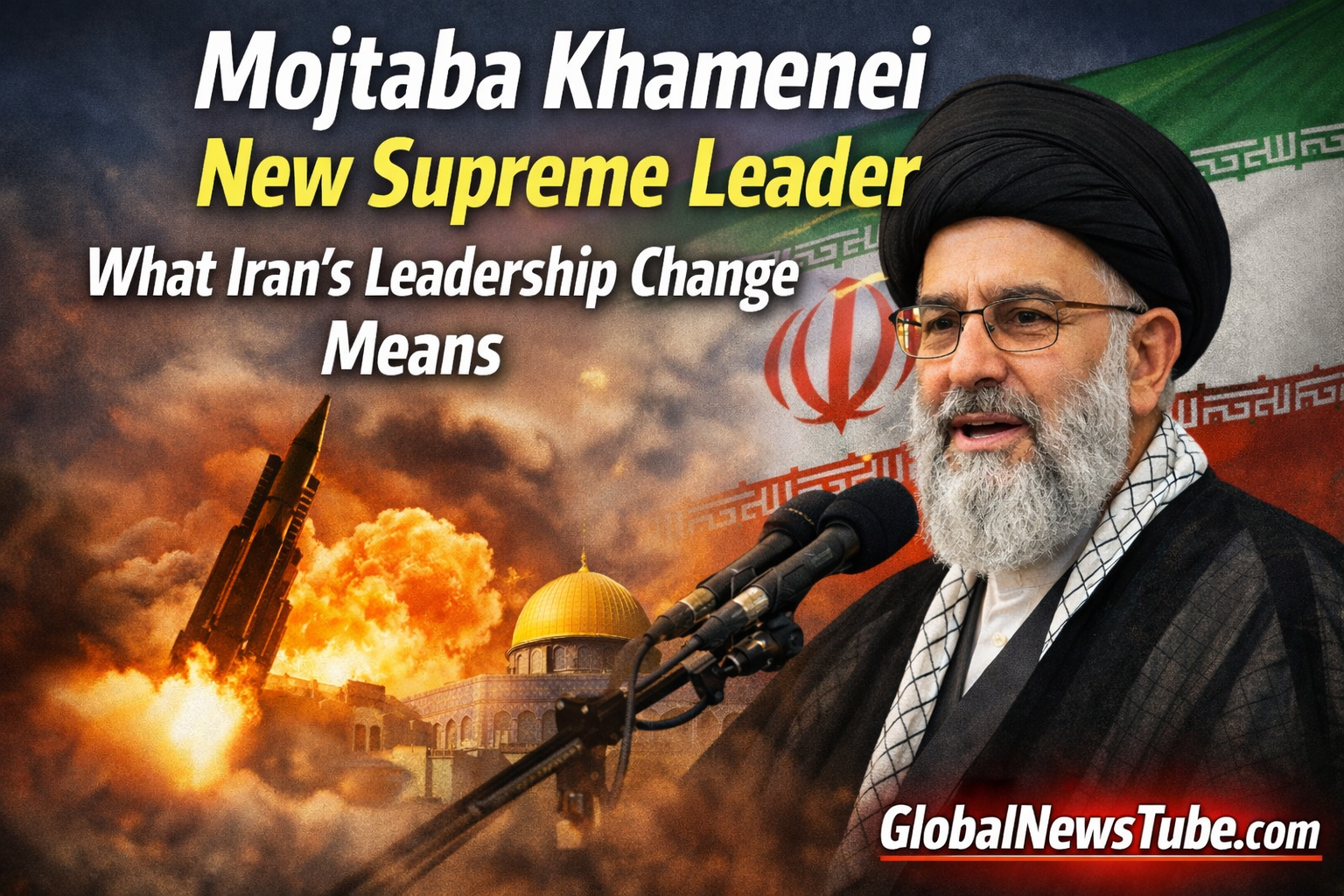
Mojtaba Khamenei New Supreme Leader What Iran’s Leadership Change Means
The appointment of Mojtaba Khamenei as Iran’s new supreme leader marks one of the most dramatic political developments in the Middle East in 2026. The leadership transition came after the killing of Ayatollah Ali Khamenei during the early phase of the current war, pushing Iran into a moment of historic uncertainty and forcing the country’s clerical establishment to move quickly.
The phrase Mojtaba Khamenei new supreme leader has quickly become central to coverage of the crisis because this is not a routine political succession. Iran’s supreme leader is the countrys most powerful figure, with authority over the armed forces, judiciary, security system, and major strategic decisions. A leadership change at that level affects not only Iran’s domestic balance of power, but also regional security, oil markets, diplomatic alliances, and the broader direction of the war.
Why Mojtaba Khameneis Appointment Matters
The rise of Mojtaba Khamenei as the new supreme leader matters because Iran is not changing leadership in a period of calm. The transition has happened during an active military confrontation involving Iran, Israel, and the United States, with related instability spreading into neighboring areas and major trade routes. That timing alone gives the succession enormous geopolitical weight.
In normal circumstances, a leadership transition in Iran would already attract global attention. In wartime, it becomes far more consequential. The new supreme leader inherits a country under direct military pressure, an economy facing disruption, and a region watching every signal coming out of Tehran. This means the story is not just about succession. It is about whether Iran’s next phase will be defined by continuity, escalation, or recalibration.
Iran New Supreme Leader and the Question of Continuity
One of the biggest questions surrounding the Iran new supreme leader transition is whether Mojtaba Khamenei will preserve the same ideological and strategic framework that defined his fathers rule. Reports suggest that Iran’s clerical and military leadership moved quickly to rally behind him and project unity, a sign that the system wanted to avoid a vacuum at the top during war.
That effort to present continuity is politically important. In a crisis, regimes often try to reduce uncertainty by showing that institutions remain intact. By elevating Mojtaba Khamenei rapidly, the Iranian establishment appears to be signaling that command structures are still functioning and that the Islamic Republic intends to project stability despite major losses and external attacks. This is why the keyword Iran leadership change is so important for SEO and for understanding the event itself the transition is not merely symbolic, but central to the states attempt to maintain authority.
Mojtaba Khamenei Iran Leadership and Regional Impact
The story of Mojtaba Khamenei Iran leadership goes beyond internal politics. Regional actors are already reading the transition through the lens of war, deterrence, and alliance building. Foreign governments have also used the succession to send their own geopolitical messages.
That matters because reactions from abroad help shape how a new leader is perceived. Diplomatic recognition, even when symbolic, can strengthen legitimacy narratives during a sensitive transfer of power. In Irans case, outside support from anti Western states may be used to reinforce the message that the country is not isolated and that its leadership transition has political backing beyond its borders. At the same time, such support may deepen concern in Western capitals about emerging or more visible anti Western alignment.
Iran Supreme Leader Transition During War
The Iran supreme leader transition is unusual because it has unfolded alongside a widening conflict that has already affected civilian areas, energy infrastructure, diplomatic missions, and maritime trade.
Strategic Meaning of the New Leadership Change
From an SEO perspective, the focus keyword Mojtaba Khamenei new supreme leader belongs naturally in any discussion of regional consequences because the appointment sits at the center of several major themes wartime succession, leadership legitimacy, foreign policy continuity, and geopolitical signaling.
Strategically, the transition may allow Iran to show that its system can survive a direct leadership shock. Symbolically, it gives the state a chance to frame continuity as resilience. Internationally, it forces governments around the world to respond to a new power center in Tehran while conflict is still underway. That combination is exactly why this story has become one of the defining Middle East developments of 2026.
Conclusion
The appointment of Mojtaba Khamenei as Iran’s new supreme leader is a turning point with consequences far beyond Iran’s borders. It comes at a time of war, instability, and intense international scrutiny, making this one of the most significant leadership changes in the region in decades. The transition is not just about succession. It is about legitimacy, continuity, foreign reactions, and the next stage of a broader regional crisis.