


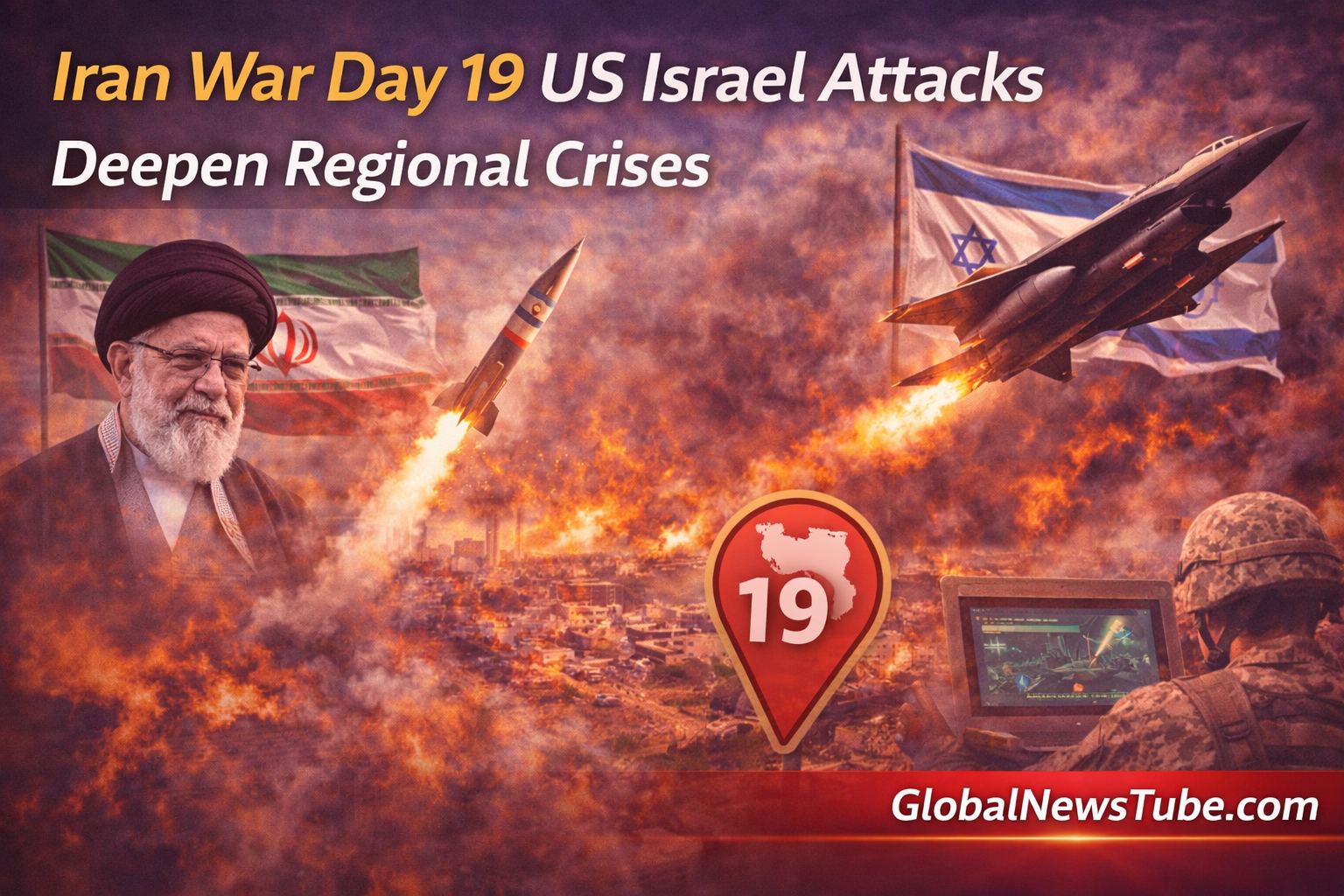
A Dangerous Turning Point in the Iran War
Iran war day 19 marks one of the most volatile moments yet in the expanding conflict involving Iran, Israel and the United States. What began as a military confrontation has now widened into a regional crisis touching the Gulf, Iraq, Lebanon and even political debates inside Washington. The latest developments show that the war is no longer defined only by air strikes inside Iran or missile attacks on Israel. It is increasingly becoming a broader regional confrontation with serious military, economic and diplomatic consequences.
According to day 19 developments, Iran vowed revenge after Israeli strikes killed senior security figures Ali Larijani and Basij commander Gholamreza Soleimani. Tehran then launched more attacks on Israel, while the conflict also spilled into Gulf countries through missiles, drones and security alerts. This mix of assassinations, retaliation and cross border fallout is what makes day 19 especially important. It highlights how quickly the situation is moving from direct state confrontation to wider regional instability.
Why Day 19 Matters in the Iran Israel War
The main reason Iran war day 19 matters is that the conflict now appears to be operating on multiple fronts at the same time. In Iran, the killings of high ranking officials represent a major political and symbolic blow. In Israel, retaliatory attacks have caused deaths, injuries and property destruction. In the Gulf, neighboring states are dealing with interceptions, security warnings and growing concern over airspace and maritime safety. In Iraq and Lebanon, military and proxy linked incidents add yet another layer of instability.
This means the crisis is no longer easy to frame as a limited exchange. Every new strike creates the risk of another response, and every response opens the door to miscalculation. For international observers, day 19 is not just another update. It is a warning sign that the conflict may be moving deeper into a prolonged and harder to contain war.
Iran Position After High Profile Killings
One of the biggest developments on day 19 is Iran’s reaction to the deaths of Ali Larijani and Gholamreza Soleimani. Tehran is mourning the loss of both figures, and analysts suggest the killing of Larijani may have wider diplomatic consequences because he had been seen as someone capable of helping create space for negotiation. That makes the attack politically significant, not just militarily important.
Iran’s foreign minister, Abbas Araghchi, also used the moment to blame the United States for the war spreading across the region. He argued that the American military presence in the Gulf makes escalation harder to avoid. This is a crucial part of Tehran’s messaging. Iran wants to show that it is not isolated in the conflict narrative and that Washington shares responsibility for the expanding crisis.
Retaliatory Attacks on Israel Intensify the Conflict
Another major aspect of Iran war day 19 is the continuing missile and rocket pressure on Israel. Iranian attacks caused major property damage and followed an earlier strike that killed two people in Ramat Gan near Tel Aviv. These attacks are important because they increase domestic pressure inside Israel for stronger retaliation. Once civilian deaths occur in urban centers, public calls for escalation usually grow louder.
Gulf Countries Face Growing Security Pressure
The regional spillover is one of the most important themes of the day 19 update. Missiles and drones have been targeting Gulf countries, with attacks or incidents reported in Saudi Arabia, Kuwait and Jordan. Qatar said missiles were intercepted, Bahrain sounded warning sirens, and British Airways extended the suspension of flights to Doha until April 30 because of instability in the airspace. The UAE also reported successful interceptions with no injuries.
These events show that Gulf states are no longer just watching from the sidelines. They are being forced to respond directly to the security consequences of the war. That matters for trade, travel, diplomacy and energy markets. When regional capitals begin activating emergency systems and aviation routes are disrupted, the conflict starts to affect far more than military planners. It begins to reshape everyday regional risk.
The Strait of Hormuz and Economic Concerns
Day 19 also carries major economic significance because of continued attention on the Strait of Hormuz. Iran is allowing a small but growing number of commercial ships through the waterway, with eight non Iranian vessels detected on Monday. At the same time, US political rhetoric has focused on Iran influence over the strait, underscoring how central this shipping route remains to global economic concerns.
Even limited disruption around Hormuz can raise serious fears about oil flows, shipping insurance costs and broader commercial instability. That is why every update on maritime movement now matters. The war is not only about military losses and retaliatory strikes. It is also about chokepoints, supply lines and the possibility that a regional conflict could create worldwide economic fallout.
Tensions Rise in the US Lebanon and Iraq
The conflict political impact is also growing outside the immediate war zone. In the United States, a senior counterterrorism official, Joe Kent, resigned and publicly criticized the war, saying it began under Israeli pressure. President Donald Trump also criticized NATO allies and partners for not offering stronger military support. These developments suggest that the war is becoming politically divisive even within the US national security environment.
Meanwhile, Israel expanded evacuation orders in southern Lebanon, and deadly raids were reported in the Bekaa Valley. In Iraq, attacks were reported near the US embassy in Baghdad and claims of responsibility came from an armed Iraqi group. Together, these developments show that day 19 is not a narrow bilateral moment. It is part of a conflict web stretching across multiple countries and armed actors.
Final Thoughts on Iran War Day 19
Iran war day 19 stands out because it captures the full scale of the crisis leadership assassinations, retaliatory attacks, Gulf insecurity, maritime pressure and political fallout in Washington. This is no longer a conflict that can be described simply as Iran versus Israel. It now involves regional air defense systems, international diplomacy, commercial shipping concerns and growing fears of a broader war.
The biggest takeaway is clear. Day 19 shows how fast escalation can spread when military strikes, symbolic retaliation and regional alliances all collide at once. For readers tracking the conflict, the core issue is no longer whether the war is expanding. It is how much more damage the region can absorb before the crisis turns into an even wider and more devastating confrontation.