


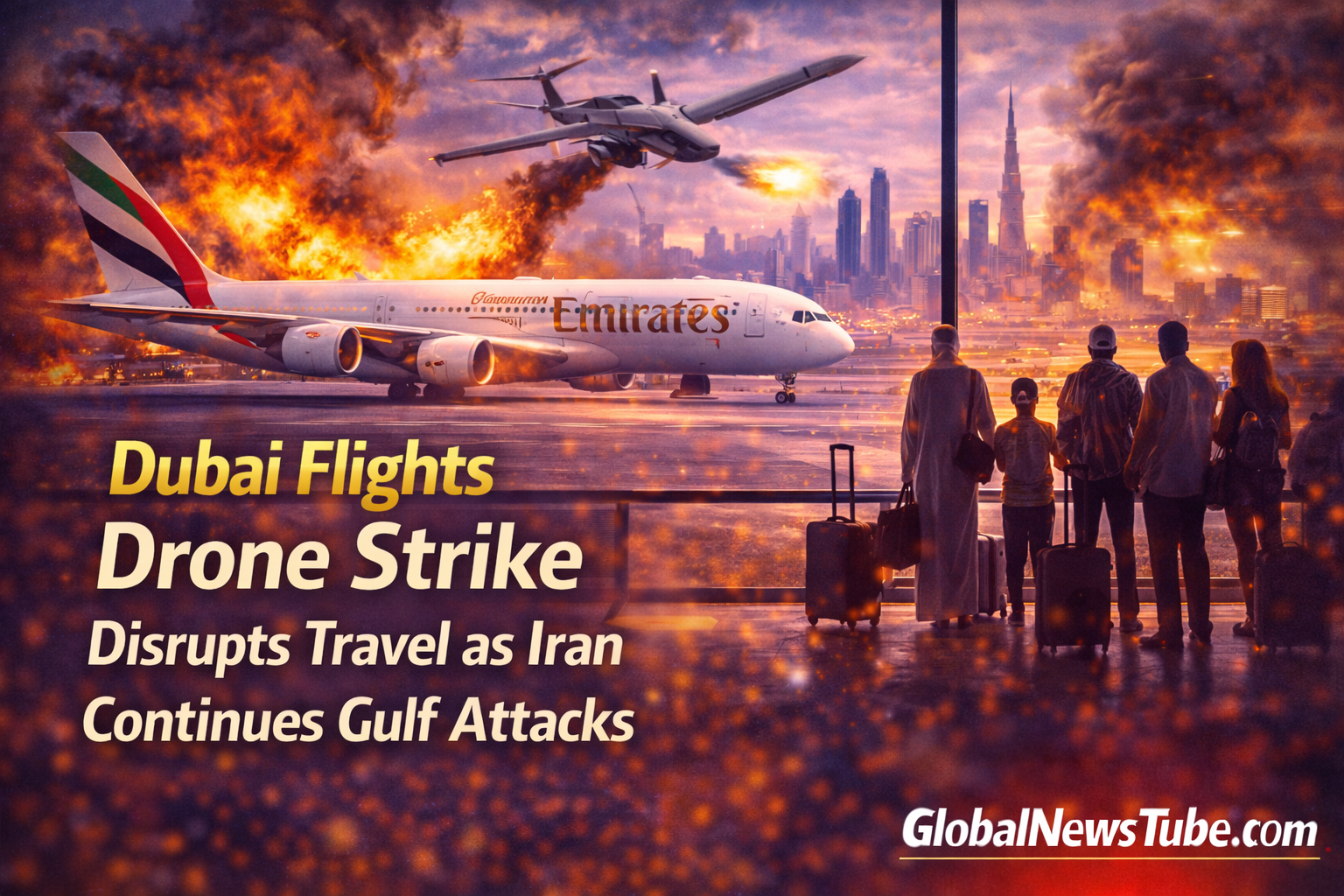
Why the Dubai Flights Drone Strike Matters
The Dubai flights drone strike has become one of the most important developments in the widening Gulf crisis because it pushed a regional war directly into one of the world’s busiest international travel hubs. On March 16, a drone strike near Dubai International Airport sparked a large fire at a fuel tank facility, forced a suspension of flight operations, and disrupted one of the busiest aviation networks on earth. Authorities later began restoring limited operations, but the attack showed how vulnerable civilian infrastructure has become as Iran’s campaign across the Gulf continues.
This matters far beyond the UAE. Dubai is not just another airport. It is a global transit center linking Europe, Asia, Africa, and the Middle East. When flights are interrupted there, the effects spread quickly across airlines, cargo chains, tourism, and business travel. Emirates halted flights at first and later resumed limited service, while other planes were diverted or delayed. That immediate disruption is why the Dubai flights drone strike became a major global story rather than a narrowly regional incident.
How the Attack Disrupted Dubai Airport
The attack disrupted Dubai airport operations at a sensitive moment for regional aviation. The strike triggered a fuel tank fire near the airport and led to a temporary suspension of flights. Roads around the airport were also affected as emergency services responded. Although no injuries were immediately reported, the operational impact was severe enough to ripple through international schedules.
The timing added to the sense of alarm. Aviation systems across the Gulf were already under pressure from airspace restrictions, reroutings, and heightened security planning. The March 16 strike therefore did not hit a normal, stable travel environment. It hit a network already stretched by conflict. That is why Gulf aviation disruption has become such an important secondary keyword in this story. The Dubai attack is not a standalone event. It is part of a wider pattern of pressure on regional transport infrastructure.
Why Iran Gulf Attacks Are Expanding the Crisis
Iran Gulf attacks have turned the conflict into more than a military contest between states. They are now affecting oil shipping, airports, fuel sites, and commercial confidence across the region. Recent coverage described ongoing attacks and interceptions involving the UAE and Saudi Arabia, while other reporting linked the Dubai airport disruption to the broader Iranian retaliation campaign unfolding after the current round of war escalated.
This wider context is essential for understanding the story. A drone strike on Dubai airport is not only about aviation safety. It is also about economic signaling. By targeting infrastructure in the Gulf, Iran increases pressure on states seen as aligned with Washington or at least connected to the broader conflict environment. The result is a strategy that goes beyond battlefield damage. It aims to create instability, raise costs, and spread fear through everyday systems that millions of civilians rely on.
The Economic Impact of Dubai Airport Disruption
Dubai airport disruption has immediate economic consequences because Dubai International Airport is central to tourism, trade, and global business mobility. The airport handled tens of millions of passengers in recent years, making it one of the busiest international airports in the world. Even a short shutdown there can delay long haul routes, interrupt cargo movement, and raise costs for airlines already coping with rerouting across conflict zones.
The economic impact also extends to confidence. Airports represent reliability, order, and international connectivity. When they are hit, the message is that commercial normality is no longer guaranteed. That affects travel demand, insurance costs, airline planning, and investor sentiment. Flights from several international cities were rerouted or diverted, while alternative airports absorbed some of the traffic. That kind of displacement may be manageable in the short term, but repeated attacks can undermine the Gulf’s image as a dependable transport corridor.
Why UAE Drone Strike Concerns Are Growing
The UAE drone strike concern is growing because Dubai is not the only place under pressure. Reports have described earlier strikes or drone-related incidents affecting Dubai and other parts of the UAE during this conflict. The March 16 attack therefore reinforced an existing fear that even highly developed, heavily connected Gulf states are struggling to fully shield civilian and commercial infrastructure from repeated aerial threats.
Why the Dubai Flights Drone Strike Resonates Globally
The Dubai flights drone strike resonates globally because it combines war, travel disruption, and economic risk in one headline. Many international crises remain distant for people outside the region. This one does not. A hit on Dubai airport affects ordinary travelers, multinational companies, freight operators, and families across continents. It also arrives alongside wider fears about the Strait of Hormuz, energy supply disruption, and rising oil prices.
That combination is why the story has such strong search value. Readers are not only looking for military updates. They want to know whether flights are operating, whether the airport is safe, whether the crisis is widening, and what it means for the Gulf economy. A good Rank Math article should answer all of those concerns while keeping the focus keyword natural throughout the piece.
What This Means for Gulf Aviation Going Forward
The broader lesson is that Gulf aviation is entering a more fragile phase. Airlines can reroute some flights and airports can resume operations after short interruptions, but repeated strikes create structural pressure. They force carriers to spend more on planning and fuel, complicate insurance and staffing, and make passengers less confident about travel through affected hubs. The March 16 incident showed that even when services resume, the sense of vulnerability remains.
If attacks continue, Gulf aviation disruption could become more than a temporary crisis. It could start reshaping route planning and regional transport strategy. That would have consequences not just for airlines, but for the Gulf’s broader role as a crossroads for trade and movement between major world regions.
Conclusion
The Dubai flights drone strike is more than a dramatic incident at a major airport. It is a sign that the Gulf conflict is now hitting the infrastructure that supports global mobility and commerce. The March 16 attack disrupted flights, exposed the vulnerability of Dubai airport, and showed how Iran Gulf attacks are widening the reach of the war beyond direct military targets.
The biggest takeaway is simple. Dubai flights drone strike is not just a travel story. It is a security story, an economic story, and a regional stability story all at once. Until the wider conflict cools, Gulf airports and airlines are likely to remain under pressure, and Dubai’s disruption may be remembered as one of the clearest moments when a regional war collided with global civilian infrastructure.