


Why China 7nm Chip Production Matters Now
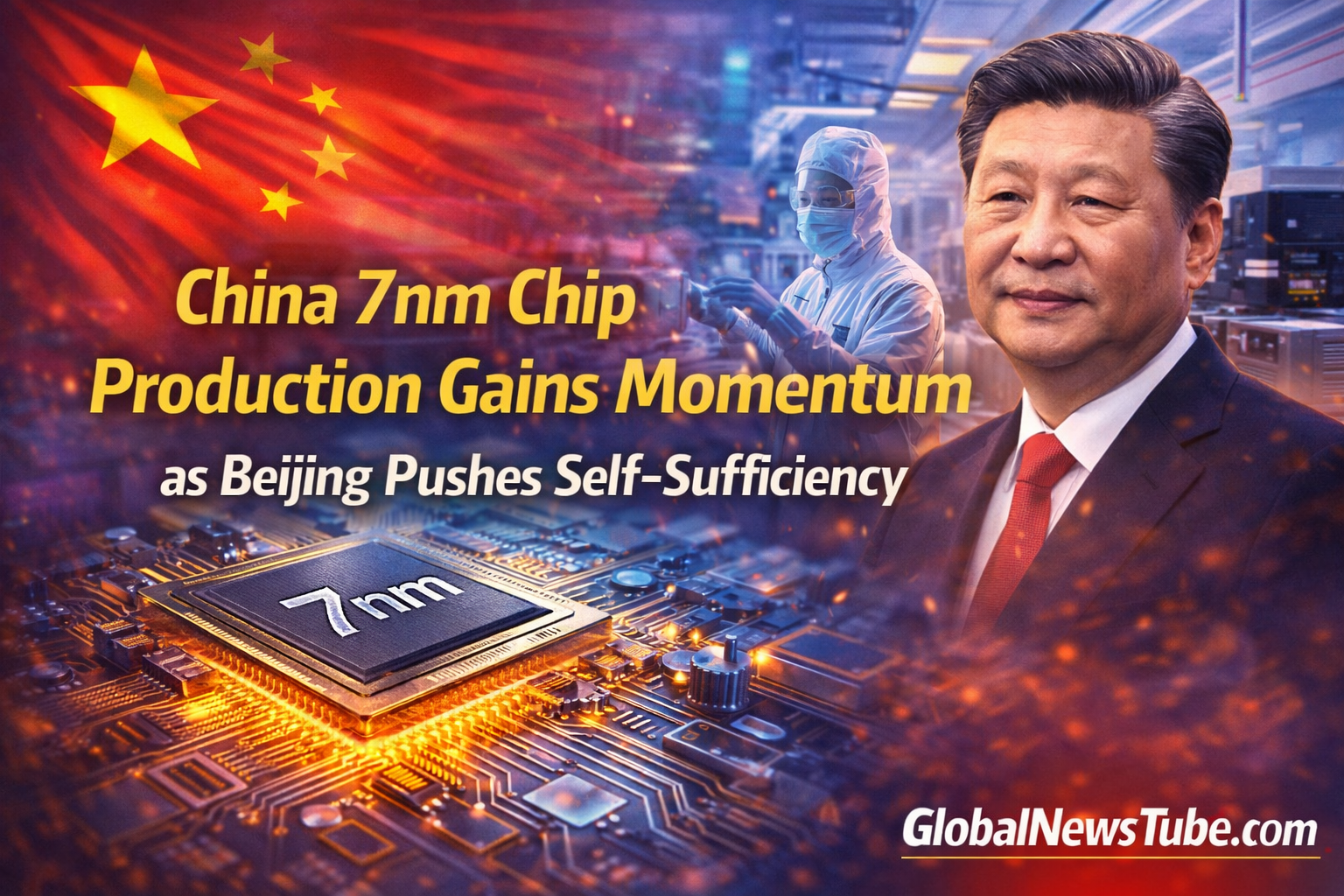
China 7nm chip production is becoming one of the most important technology stories of 2026 because it sits at the center of Beijing’s drive for semiconductor self sufficiency. The immediate trigger is the latest report that Hua Hong Group, widely described as China’s second largest contract chipmaker, is preparing a 7 nanometer process through its Huali Microelectronics unit in Shanghai. If that effort scales successfully, Hua Hong would become the second domestic foundry after SMIC able to produce chips at the 7nm level.
That matters for two reasons. First, 7nm is still considered a strategically important node for AI accelerators, advanced processors, telecom hardware, industrial systems, and defense related computing. Second, China is trying to reduce its dependence on foreign suppliers after years of export controls restricted access to top-end chipmaking tools and advanced processors. In that context, even incremental domestic progress carries major political and economic weight.
Hua Hong 7nm Is a Big Symbolic and Industrial Step
For years, SMIC has been viewed as the only Chinese foundry capable of making 7nm class chips domestically. The new Hua Hong 7nm effort changes the story because it suggests China is building depth rather than relying on a single national champion. That is important in any semiconductor ecosystem. One company can prove a technology is possible, but broader industrial capacity is what turns that proof into a sustainable supply chain.
Hua Hong’s move also fits a broader pattern. China wants to expand 7nm and 5nm equivalent capacity sharply over the next two years. Those ambitions show that Beijing is not treating advanced chip manufacturing as a prestige project alone. It is trying to build meaningful scale, especially for domestic AI demand.
China Chip Self-Sufficiency Is Driving the Push
China chip self sufficiency has been a policy goal for years, but the pressure has intensified as semiconductor technology has become central to AI, cloud infrastructure, military systems, electric vehicles, and industrial automation. The more advanced the chip, the more strategic the dependency. That is why Beijing has been willing to spend heavily on fabs, equipment, local design ecosystems, and domestic substitutes for foreign technology.
China is still far from full semiconductor independence, but the direction is clear. The country is trying to close the gap across several layers of the supply chain at once. That broader context explains why China 7nm chip production is about more than one factory line. It is about whether China can create enough domestic capacity to support its own computing ambitions without depending on unrestricted access to foreign technology.
Why Advanced Chip Manufacturing China Still Faces Limits
Even with this progress, advanced chip manufacturing China still faces serious constraints. The biggest challenge is equipment. Leading edge manufacturing normally depends on highly sophisticated tools from global suppliers, especially lithography systems. Because of export restrictions, Chinese foundries have had to use older toolsets in more complex ways, which can raise costs, reduce yields, and slow production scale up.
That is why many analysts treat 7nm as both an achievement and a ceiling. China has shown it can push older equipment further than many expected, but doing so efficiently at scale is much harder than proving a process in limited volumes. The question is no longer only whether China can make 7nm chips. It is whether it can do so cheaply enough, reliably enough, and broadly enough to support major commercial demand.
This distinction matters because China 7nm chip production should not be framed as a simple breakthrough headline. The more accurate interpretation is that China is widening domestic advanced node capability while still operating under major technical and equipment constraints.
Beijing Chip Strategy Is Becoming More Practical
What stands out about the current Beijing chip strategy is that it looks increasingly practical rather than purely aspirational. Instead of promising immediate parity with TSMC or Samsung at the frontier, China appears focused on expanding capacity at nodes that are still useful for real products, especially AI chips tailored for domestic deployment.
That may prove to be Beijing’s most realistic route forward. Full leadership at the very latest nodes is still difficult under sanctions, but strong domestic capability at 7nm class production could still support a wide range of national priorities. In semiconductors, being good enough at scale can matter almost as much as being best in class in small volumes.
What This Means for the China Semiconductor Industry
For the China semiconductor industry, Hua Hong’s 7nm preparations send a powerful signal. They suggest that China’s chip ecosystem is slowly becoming more redundant, more resilient, and more internally connected. A single company model is fragile. A multi company ecosystem is harder to block and easier to expand over time.
There is also an important confidence effect. When one foundry demonstrates a workable path and another begins following it, suppliers, policymakers, chip designers, and local governments all gain stronger incentives to invest. That does not remove the bottlenecks, but it can accelerate the ecosystem around them. In semiconductors, momentum matters because each improvement in process capability, tooling, materials, and design support reinforces the next one.
This is why China 7nm chip production should be seen as part of a larger industrial story. It is not only about who can make a smaller chip. It is about how a country under external restrictions builds alternative capacity across design, manufacturing, packaging, and equipment procurement.
Conclusion
China 7nm chip production is gaining momentum at a time when semiconductor self sufficiency has become a national priority. The reported Hua Hong 7nm push does not mean China has solved its advanced manufacturing problem, and it does not place Chinese foundries on equal footing with the world’s leading chipmakers overnight. But it does show that Beijing’s strategy is producing results that are broader than before.
The bigger takeaway is simple. China is no longer relying on one isolated proof point. It is trying to turn advanced node capability into a wider domestic base. If Hua Hong succeeds in scaling 7nm production, the political message will be clear, the industrial impact will be meaningful, and the global chip race will become even more competitive. That is why China 7nm chip production is such an important story for 2026.