


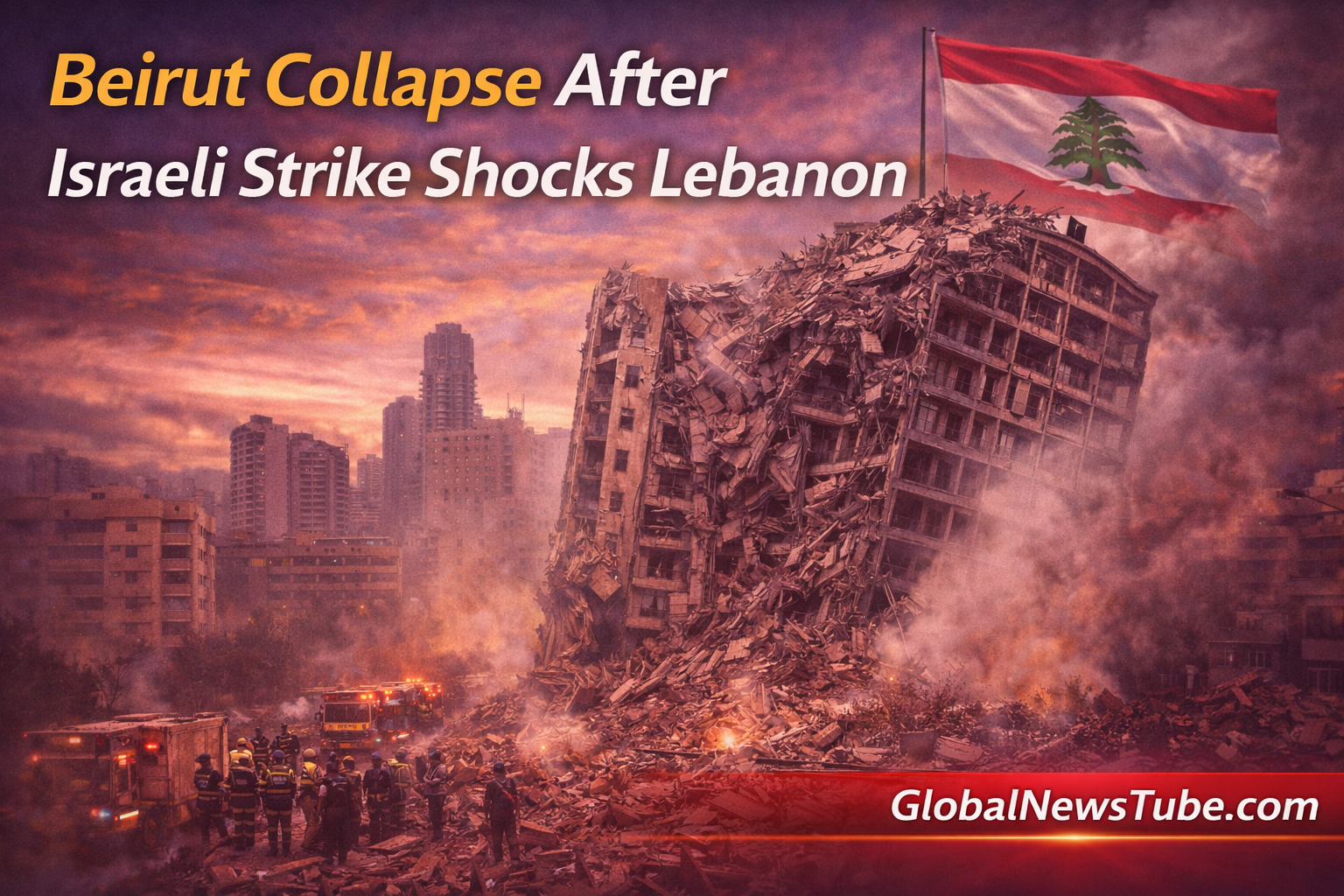
Beirut Building Collapse Caught Global Attention
The Beirut building collapse after an Israeli strike has become one of the most alarming images to emerge from the latest escalation in Lebanon. Video footage published on March 18, 2026, showed a multistorey building in central Beirut collapsing into rubble after being hit, turning an already tense regional conflict into a deeply visual reminder of urban destruction and civilian fear. The strike took place in Bashoura, a central Beirut neighborhood, during a broader wave of Israeli attacks that also hit nearby Zuqaq al Blat.
For search readers trying to understand why this story matters, the answer is simple. A Beirut building collapse is not only a local tragedy. It is a symbol of how the Israel Lebanon conflict has intensified inside dense urban areas, where military operations and civilian life now overlap in the most dangerous ways. Once buildings in the center of a capital city start falling on camera, the political and humanitarian meaning of the war changes immediately.
What Happened in Central Beirut
According to current reporting, the building collapse followed an Israeli strike on a property in Bashoura after an evacuation warning was issued around 4 a.m. local time. The collapse was described as part of four Israeli strikes that hit central Beirut that morning, while Israel said the attacks were aimed at Hezbollah infrastructure.
The wider death toll also made the incident more serious than a single dramatic video moment. Lebanon health ministry said at least 12 people were killed in central Beirut strikes on Wednesday, with dozens more wounded. These figures underline the scale of the danger for civilians living in heavily populated districts.
Why the Beirut Building Collapse Matters
The Beirut building collapse matters because it shows how central Beirut is no longer insulated from the wider war. In past phases of conflict, strikes in Lebanon often drew immediate attention when they hit southern suburbs or border areas. But attacks in core districts of the capital create a different level of alarm. Bashoura and Zuqaq al Blat are not remote military zones. They are urban neighborhoods where residents, businesses, roads and public life exist side by side.
Civilian Fear and Displacement in Lebanon
The building collapse also fits into a broader humanitarian crisis across Lebanon. More than a million people have been displaced by bombings and displacement orders, while areas in southern Lebanon have faced evacuation warnings and intense air strikes.
These figures matter because a collapsing building is never just about one structure. It reflects a wider condition of insecurity in which residents no longer know which neighborhood may be hit next, how much warning they will get, or whether evacuation is realistically possible. In dense cities, even a warning can mean chaos. Families may have only minutes to decide what to take, where to go and whether roads will remain open. That makes every strike part of a much bigger story of fear, flight and instability.
Israel Stated Reason for the Strike
Israel said the strike targeted Hezbollah linked infrastructure. In the specific case of the collapsed Beirut building, the claim was that the site was connected to financing or support for Hezbollah activities. These statements are part of Israel ongoing argument that such strikes are aimed at militant assets rather than civilians, even when they occur inside crowded urban environments.
But the visual evidence of a building collapsing in the middle of the city inevitably shifts public attention to civilian risk. Images of rubble, emergency workers and damaged neighborhoods tend to dominate public discussion far more than military justifications. That is especially true when the strike occurs in a capital city and the footage spreads quickly across international media and social platforms. The result is a renewed debate over proportionality, warning systems and the humanitarian cost of urban warfare.
The Regional Context Behind the Strike
This Beirut strike did not happen in isolation. It came during a much wider conflict involving Israel, Hezbollah, Iran and the United States. On the same day, Israel said it had killed another senior Iranian official, while Iran launched retaliatory attacks on Israel and Gulf states. The regional war has already driven up oil prices, disrupted shipping around the Strait of Hormuz and spread military pressure across several countries.
That regional backdrop matters because it explains why a Beirut building collapse has global resonance. This is not only a Lebanon story. It is part of a larger Middle East crisis in which local strikes can affect diplomacy, aviation, energy markets and regional security calculations. A single collapsing building in Beirut becomes part of the evidence that the war is widening geographically and intensifying politically.
Final Thoughts
The Beirut building collapse after an Israeli strike is one of the clearest signs yet that Lebanon is facing a harsher and more dangerous phase of war. The destruction in Bashoura, the casualties reported in central Beirut and the wider pattern of displacement all point to a conflict that is expanding both geographically and psychologically. Even when warnings are issued, the collapse of a multistorey building in a crowded city center sends a message of extreme insecurity.
For readers following this story, the main takeaway is clear. The Beirut building collapse is not just a viral video or a single strike report. It is a window into the urban cost of a regional war that continues to deepen, pulling more civilians, neighborhoods and cities into its path.