


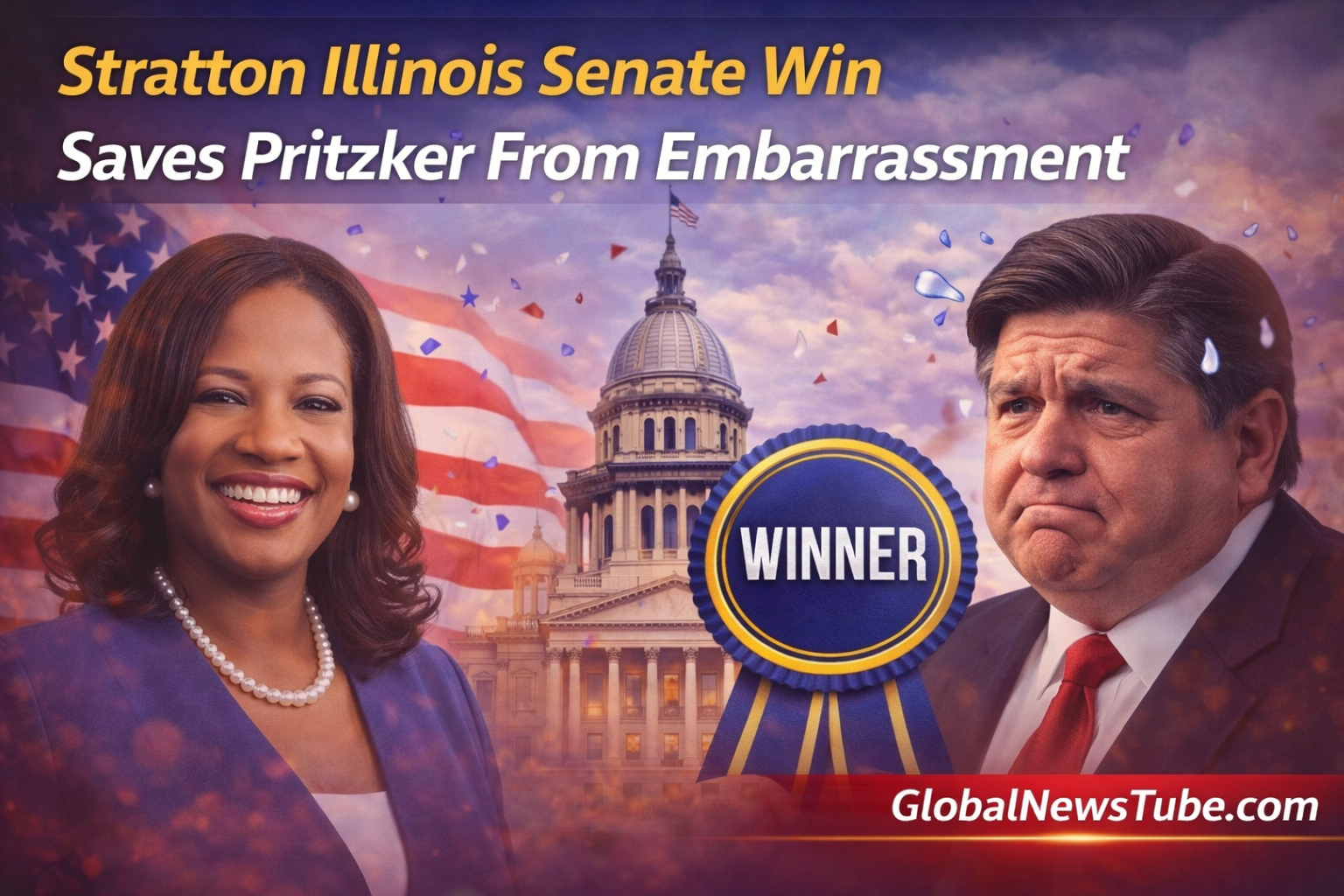
Stratton Illinois Senate Win Saves Pritzker From Embarrassment
The Stratton Illinois Senate win is more than a primary night headline. It is a major test of political influence, party control, and leadership inside Illinois Democrats. Lieutenant Governor Juliana Stratton won the Democratic primary for the open U.S. Senate seat after Senator Dick Durbin announced his retirement, defeating Representatives Raja Krishnamoorthi and Robin Kelly in one of the state’s most closely watched races.
Stratton’s victory also spared Governor JB Pritzker from what many insiders viewed as a potentially damaging political embarrassment. He strongly backed her, allies tied to him poured millions into support efforts, and the race became a public measure of his power inside Illinois politics. If Stratton had lost, it would have raised serious questions about whether Pritzker still controlled the Democratic machine in his home state. Instead, her victory reinforced his standing at a moment when his national profile continues to rise.
Why the Stratton Illinois Senate Win Matters
The Stratton Illinois Senate win matters because it was not simply a contest over policy. It was also a test of influence. Stratton entered the race with Pritzker’s backing, and that support gave her structure, visibility, and institutional strength. In a crowded Democratic field, that mattered enormously. The result showed that an endorsement from the governor still carries weight, especially when combined with money, organization, and a statewide network.
This race became especially important after Durbin’s retirement created a rare open Senate seat in Illinois. Open seats attract ambitious candidates, outside spending, and internal party tensions. That is exactly what happened here. Krishnamoorthi entered with major fundraising strength, while Kelly had support from influential Black leaders and party allies. Stratton had to navigate both financial pressure and political friction, making her win far more meaningful than a routine primary result.
How Pritzker Avoided Political Embarrassment
The idea of saving Pritzker from political embarrassment fits because the governor had so much riding on the contest. He was not technically on the ballot, but politically he was everywhere in the race. The election was widely seen as a referendum on his clout. Had Stratton lost after such a public show of support, critics would have framed it as a rejection of Pritzker’s control over Illinois Democrats.
That outcome would have mattered beyond Illinois. Pritzker is often mentioned as a possible national figure in future Democratic politics, and races like this shape how donors, activists, and party leaders judge political strength. Winning at home still matters in national politics. Stratton’s victory allowed Pritzker to avoid a messy setback that opponents could have used as proof that his influence is overstated. Instead, he now looks like a governor who can still shape major outcomes in his state.
Juliana Stratton Path to Victory
Juliana Stratton did not win in an easy environment. Krishnamoorthi brought strong fundraising advantages, and outside groups spent heavily during the race. The contest became more expensive and volatile as money poured in late. Stratton still emerged on top, thanks in part to strong support in Cook County and the institutional backing that came with being the sitting lieutenant governor.
Her campaign also benefited from the ability to present herself as both experienced and historic. If elected in November, Stratton could become one of the few Black women ever elected to the U.S. Senate. That gave her candidacy significance beyond state politics and helped energize support among voters looking for both continuity and representation. Endorsements from powerful Democratic figures and organizations also strengthened her position inside the party coalition.
What the Illinois Senate Primary Revealed
The Illinois Senate primary exposed real tensions inside the Democratic Party. It was not just a contest between personalities. It also reflected disagreements over ideology, race, donor power, and the role of wealthy backers in shaping nominations. Some supporters of rival candidates openly criticized Pritzker’s involvement and argued that he was tilting the race too aggressively.
At the same time, the contest showed how modern primaries are increasingly shaped by outside spending and aggressive messaging. Even in a strongly Democratic state, money and political machinery remain decisive. Stratton’s win demonstrated that organization still matters, but it also highlighted the discomfort many Democrats feel when aligned PACs and wealthy supporters become major forces in choosing nominees.
What This Means for Pritzker Future
For Pritzker, the result is clearly positive. He avoided a painful headline and gained a victory that reinforces his reputation as one of the Democratic Party most effective governors. That matters not only for Illinois but for any broader ambitions he may have. Political observers often watch whether governors can influence races beyond their own campaigns. In this case, Pritzker proved that his support still carries force in a high stakes statewide contest.
Still, the result does not erase the tensions that surfaced during the race. Some Democrats remain uneasy about how much influence he exercised, and the primary showed that party unity cannot be assumed. Stratton’s win may calm those concerns for now, but the deeper questions about power, money, and party direction will remain part of Illinois politics going forward.
The General Election Ahead
Stratton now moves to the general election with momentum and clear advantages. Illinois remains a Democratic leaning state, so she enters the next phase from a position of strength. Even so, general elections are different from primaries. Voters broaden, scrutiny intensifies, and campaigns must shift from coalition building inside one party to making a statewide case to everyone.
For Stratton, that means turning a primary win into a broader message about leadership, representation, and continuity after Durbin. For Pritzker, it means making sure this victory becomes the foundation of a united Democratic front rather than a lingering source of resentment among rivals and their supporters.
Conclusion
The Stratton Illinois Senate win was not just another primary result. It was a defining test of whether JB Pritzker could still shape the direction of Democratic politics in Illinois. By winning, Stratton positioned herself strongly for November and protected Pritzker from a politically damaging loss in a race where he had invested both money and prestige.
This story matters because it combines political drama, party power, and future ambition. It tells voters and party insiders that Pritzker’s influence remains intact, at least for now. That is why the Stratton Illinois Senate win reaches beyond one primary night. It reshapes the Illinois Democratic map and strengthens the governor who had the most to lose.