


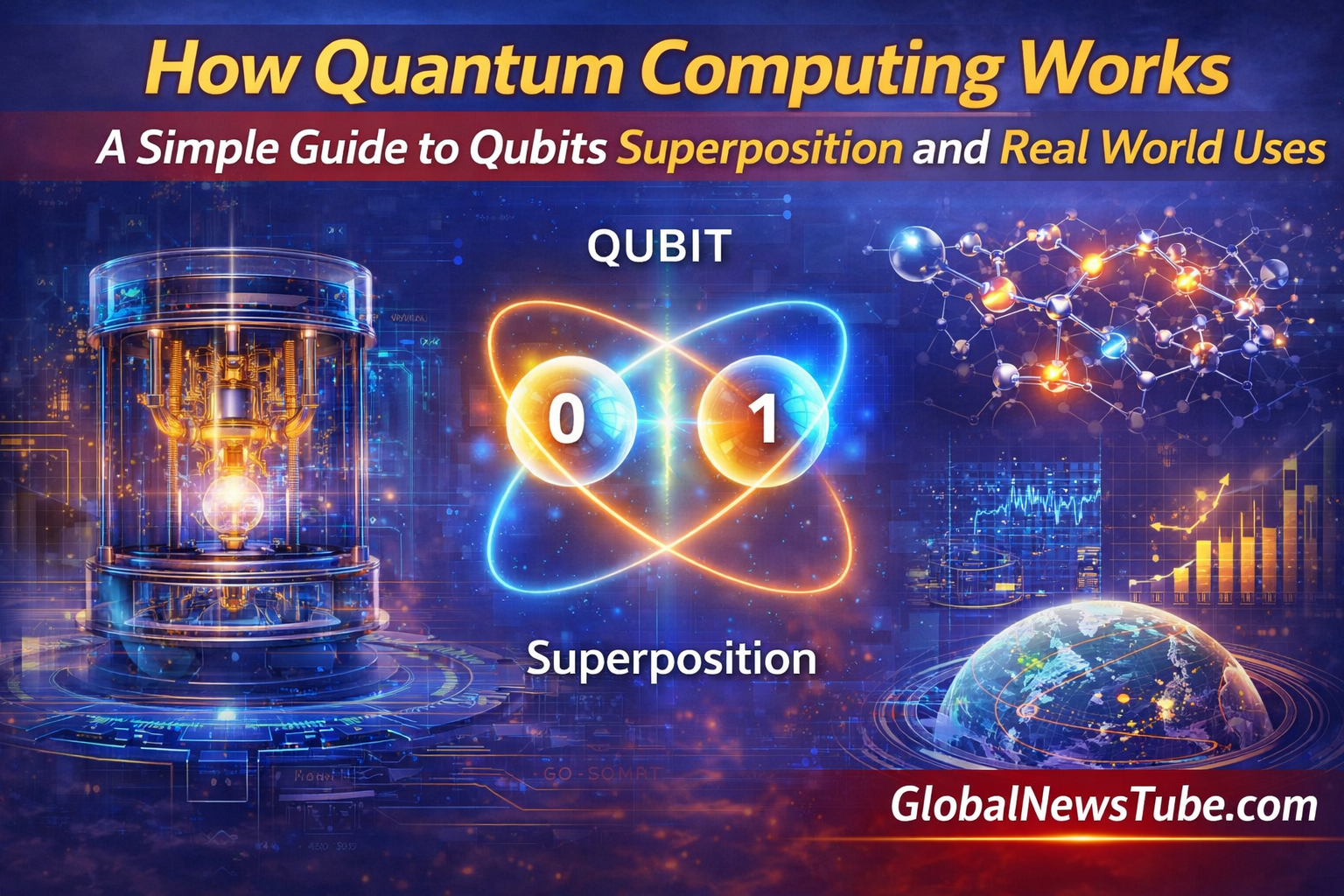
How Quantum Computing Works A Simple Guide to Qubits Superposition and Real World Uses
Understanding how quantum computing works has become increasingly important as the technology moves from theory into real world experimentation. Quantum computing is often described as the next major leap in computing, but it is not simply a faster version of today’s laptops or servers. Instead, it uses the laws of quantum physics to process information in a fundamentally different way.
To understand how quantum computing works, it helps to start with the difference between classical bits and quantum bits. Classical computers store information in bits, and each bit is either a 0 or a 1. Quantum computers use qubits instead. A qubit can represent 0, 1, or a quantum combination of both at the same time.
What Is a Qubit
A qubit is the basic unit of quantum information. If a normal bit is like a coin lying heads or tails, a qubit is more like a spinning coin that can contain aspects of both until it is measured. This does not mean a qubit magically gives every possible answer at once. It means quantum systems can represent probabilities and combinations in ways that classical systems cannot.
This feature is what makes quantum computing explained so different from ordinary computing. Instead of testing possibilities one by one in a straightforward binary way, quantum systems can encode a much richer structure of information.
Superposition and Why It Matters
One of the most important ideas in how quantum computing works is superposition. In quantum physics, very small systems do not always behave like ordinary objects. At atomic and molecular scales, particles can exist in multiple possible states until they are measured.
In practical terms, superposition allows qubits to carry more complex information than classical bits. This is why quantum computers are promising for certain kinds of hard problems, especially those involving huge combinations, physical simulation, and advanced optimization.
Still, superposition alone does not create useful results. Quantum algorithms must be carefully designed so that the right answers become more likely when the system is measured. That is where quantum gates and interference come in.
Quantum Gates and Quantum Circuits
Just as classical computers use logic gates to manipulate bits, quantum computers use quantum gates to manipulate qubits. These gates change the probability patterns of qubits and steer the system toward useful outcomes.
A sequence of these operations forms a quantum circuit. In simple terms, a quantum circuit is a structured series of steps that transforms qubits from their starting condition into a state that can produce a meaningful answer when measured.
The challenge is that quantum information is delicate. Small disturbances from the environment can introduce noise, which changes the result. That is one reason why building reliable quantum computers is so difficult.
Why Today Quantum Computers Are Still Limited
A common misunderstanding in discussions about quantum computing applications is that practical, large scale quantum computers are already here. They are not. Today quantum processors are still limited by noise, instability, and short coherence times.
These machines can perform some specialized tasks, but they are still far from replacing ordinary computers. In fact, classical and quantum computers are more likely to work together, with quantum machines handling certain difficult tasks while classical systems continue doing most routine computation.
This is one of the most important realities to remember when explaining how quantum computing works. The promise is real, but so are the limitations. Quantum systems are highly sensitive to their surroundings, which means heat, radiation, and other interference can create errors very easily.
Error Correction Is the Big Breakthrough Still Needed
If quantum computing is going to become broadly useful, error correction will be essential. Qubits are so sensitive that even tiny environmental disturbances can introduce mistakes. Researchers need ways to protect information and correct faults without destroying the quantum state.
This is why so much of the race in quantum computing is not just about adding more qubits. A machine with many noisy qubits may be less useful than a smaller one with better stability and error control. In other words, quality matters just as much as quantity.
Quantum error correction is one of the hardest engineering problems in the field. It requires encoding information across multiple physical qubits so that the logical information can survive even when some parts of the system fail. Until this challenge is solved at scale, quantum computers will remain limited in what they can do reliably.
Real World Uses of Quantum Computing
The reason so many governments and companies are investing in this field is that quantum computing applications could be significant. Researchers believe quantum systems may eventually help with drug discovery, materials science, industrial chemistry, financial modeling, and optimization problems.
These applications make sense because many natural systems, especially molecules and materials, already behave according to quantum rules. Classical computers often struggle to simulate them efficiently. Quantum computers, at least in principle, may model them more naturally.
Cybersecurity is another major issue. Powerful quantum computers could one day break some forms of current encryption. That is why governments, scientists, and cybersecurity experts are already preparing new approaches known as post quantum cryptography to protect digital systems against future quantum threats.
Another likely use is optimization. Businesses often need to solve complex scheduling, logistics, and resource allocation problems with countless variables. Quantum computers may eventually offer advantages for selected tasks in these areas, though practical results are still in development.
What Quantum Computing Will Not Do
It is just as important to understand what quantum computing will not do. It will not instantly replace all traditional computers. It will not make every software task faster. Browsing the web, writing documents, sending emails, and streaming video will still rely on classical systems.
That means the future is likely to be hybrid. Businesses and researchers may use classical machines for general purpose tasks and quantum systems for selected problems in science, optimization, and cryptography.
This is a key point in quantum computing explained for general readers. Quantum computing is powerful because it is specialized, not because it is universally better. It is designed for a narrow but important category of problems that classical computers struggle to solve efficiently.
Why Quantum Computing Matters for the Future
The growing interest in how quantum computing works reflects a broader shift in technology. As classical computing reaches practical limits in some areas, researchers are looking for new approaches that can unlock fresh capabilities.
Quantum computing matters because it could change how humanity solves some of its hardest scientific and industrial problems. It may lead to breakthroughs in medicine, cleaner energy technologies, faster material discovery, and more advanced artificial intelligence tools. At the same time, it also forces governments and industries to rethink digital security and technological competitiveness.
This is why countries around the world are investing heavily in quantum research. The field is no longer just academic. It is becoming part of national strategy, business innovation, and long term scientific planning.
Conclusion
The best way to understand how quantum computing works is to see it as a new model of computation built on qubits, superposition, and carefully controlled quantum operations. Unlike classical computers, quantum systems can represent richer states of information and may solve certain types of problems far more efficiently.
But today’s devices are still noisy, limited, and dependent on major advances in error correction before they become widely useful. That is why quantum computing explained is both exciting and realistic at the same time. The technology is powerful in concept, promising in research, and still early in practice.
For now, the most accurate view is that quantum computing is not replacing classical computing. It is building a new layer of computational power that could transform selected industries once the science and engineering catch up to the ambition.