


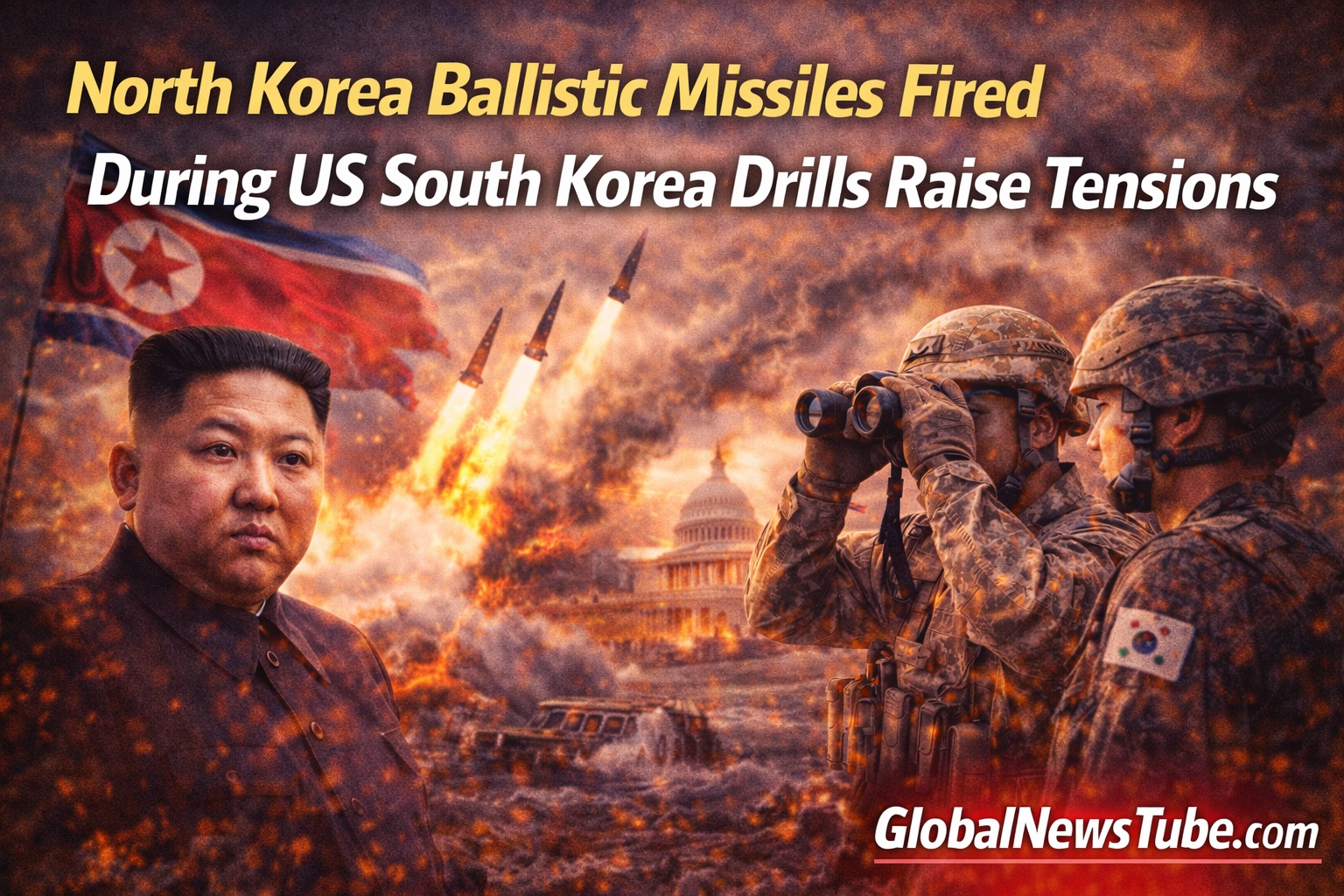
North Korea ballistic missiles are back at the center of regional security concerns after Pyongyang launched multiple suspected ballistic missiles during ongoing joint military exercises between the United States and South Korea. South Korea’s military said around 10 missiles were fired toward the eastern sea, while Japan said they landed outside its exclusive economic zone and caused no immediate damage. The launches came as the allies continued major spring drills that North Korea has long condemned as preparations for invasion.
The timing is what makes this latest incident especially important. North Korea often uses weapons tests to send political and military messages, but launching missiles during US South Korea military drills sharpens the symbolism. It shows Pyongyang is not only objecting in words but also using visible military action to reinforce its warning that joint exercises on the peninsula will be treated as a direct threat. That pattern has repeated over the years, but each new launch still adds pressure to an already tense regional environment.
According to South Korea’s military, the missiles were launched from the Sunan area near Pyongyang and traveled several hundred kilometers before landing in the sea. Even when no damage is reported, such launches matter because they test response systems, challenge deterrence, and remind neighboring countries that North Korea remains willing to escalate at politically sensitive moments.
Why North Korea Fires Missiles During Military Drills
The link between North Korea ballistic missiles and allied military exercises is not new. Pyongyang has long argued that joint US South Korean drills are rehearsals for war, even though Washington and Seoul describe them as defensive readiness exercises. The current round of drills follows the same pattern. The allies say the exercises are necessary to maintain coordination and deterrence, while North Korea frames them as provocation.
From North Korea’s perspective, missile launches during these exercises serve several purposes. First, they send a domestic message that the leadership is standing firm against outside pressure. Second, they signal to the United States and South Korea that any expansion of military cooperation will be met with a visible response. Third, they reinforce North Korea’s long running strategy of making itself impossible to ignore during moments of heightened international attention.
This is why the current North Korea missile launch 2026 story matters beyond the immediate event. It fits a broader pattern in which Pyongyang uses missile activity not simply as a weapons test, but as a form of political communication. Each launch reminds regional governments that North Korea’s military capabilities remain active and that the country is prepared to answer diplomatic or military pressure with escalation.
What the Launch Says About Korean Peninsula Tensions
The latest missile activity is another sign that Korean Peninsula tensions remain elevated and unstable. Relations between North and South Korea have been strained for years, but recent developments have pushed the atmosphere even closer to sustained confrontation. Military drills, missile launches, sanctions pressure, and the lack of meaningful diplomacy have all contributed to a cycle in which each side justifies its actions as defensive while the other sees them as aggressive.
That cycle is dangerous because it leaves little room for miscalculation. A missile launch that lands harmlessly in the sea is still a major security event. It forces governments to monitor flight paths, alert defense networks, and consider whether the action is political signaling or something more serious. In Northeast Asia, where multiple major powers operate in close proximity, even routine provocations can carry wider strategic consequences.
The latest launches also come at a time when broader global tensions are already high. That matters because regional governments are not responding to North Korea in isolation. They are doing so while managing wider military and diplomatic pressures elsewhere. In that context, a fresh North Korea missile test becomes part of a larger debate about force posture, deterrence credibility, and the readiness of US alliances in Asia.
Why the US South Korea Alliance Will Stay in Focus
The missile launches are likely to strengthen the case in Seoul and Washington for continuing, and possibly expanding, allied readiness measures. Joint drills are designed to improve coordination, response planning, and deterrence. When North Korea reacts with missile launches, that often reinforces the argument among US and South Korean officials that such exercises remain necessary.
At the same time, North Korea uses that same logic in reverse. Pyongyang portrays the drills as proof that hostile forces are tightening military pressure around it, and then points to its missile launches as justified self defense. This mutual reinforcement is one reason the security environment remains so difficult to stabilize. Each side sees its own actions as necessary and the other side’s actions as escalation.
For policymakers, this creates a familiar but difficult choice. Scaling back drills may reduce immediate tensions but could be seen as weakening readiness. Continuing them supports alliance strength but may trigger more North Korean missile activity. That is why every new episode involving ballistic missiles during military drills quickly becomes part of a wider strategic calculation rather than just a one day news event.
Regional and International Implications
The broader regional implications are significant. Japan watches these launches closely because missile activity near its waters directly affects public safety planning and national defense policy. South Korea faces the most immediate threat because of geography, while the United States sees the issue as central to alliance credibility in Asia. Each launch therefore echoes beyond the peninsula.
The latest incident also reinforces concern that diplomacy remains stalled. North Korea has shown little sign of moving back toward sustained negotiations, and its recent behavior suggests it still prefers strength signaling over compromise. That does not mean dialogue is impossible, but it does mean the short term outlook is still dominated by military messaging rather than diplomatic progress.
In practical terms, that means more missile alerts, more military monitoring, and more emphasis on deterrence. Even if the missiles do not cause physical damage, they shape the region’s strategic climate by normalizing crisis conditions. Over time, that kind of repeated confrontation can make future escalation more likely.
Conclusion
The latest North Korea ballistic missiles launch during US South Korea military drills is another reminder that the Korean Peninsula remains one of the world’s most fragile security flashpoints. The launches appear to be both a military signal and a political message from Pyongyang as allied exercises continue.
For now, the event underscores a familiar reality. North Korea is still using missile tests to challenge pressure from Washington and Seoul, and the alliance is still using joint drills to show readiness against North Korean threats. As long as that cycle continues, tensions on the peninsula are likely to remain high, with every new launch serving as another warning sign for the region.