


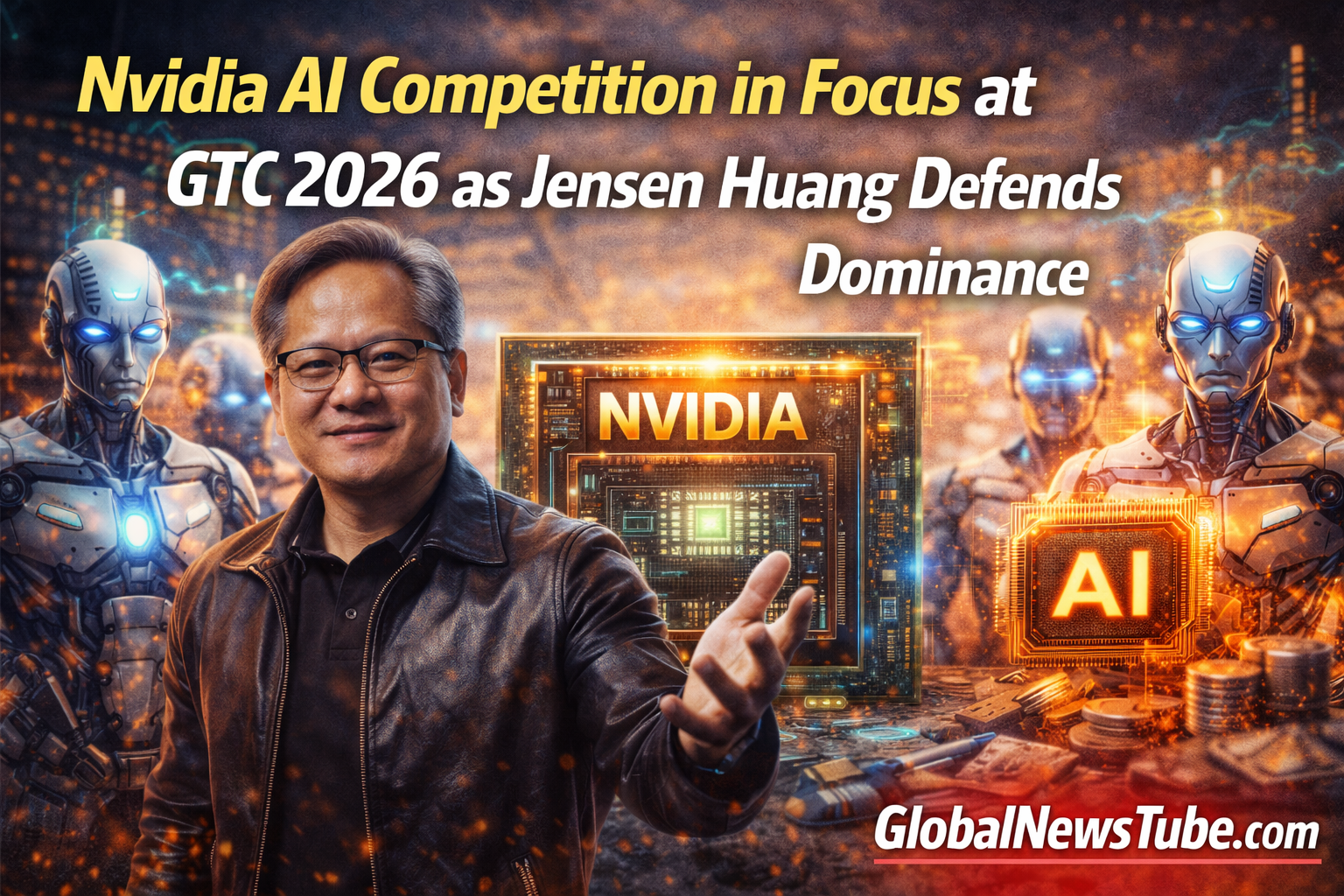
Nvidia AI Competition in Focus at GTC 2026 as Jensen Huang Defends Dominance
Nvidia AI competition is set to be one of the defining themes of GTC 2026 as investors, customers, and rivals look for signs that the chip giant can stay ahead in a rapidly changing market. Nvidia enters the event from a position of strength, but also under growing pressure. The company remains a leader in artificial intelligence hardware, yet customers are becoming more focused on cost, efficiency, and alternatives.
GTC 2026 arrives at a moment when the conversation around artificial intelligence is shifting. For the past few years, Nvidia’s dominance has been built largely on its role in training large AI models, where its GPUs became the standard for hyperscalers and AI startups. But the market is evolving. The next major battleground is inference, the stage where trained models answer questions, generate content, and run applications at scale. As that shift happens, Nvidia faces tougher competition from custom chips, lower cost alternatives, and rival approaches designed specifically for inference efficiency.
That is why Nvidia GTC 2026 matters so much. The event is expected to focus on inference, enterprise AI, robotics, and broader infrastructure, showing that Nvidia wants to be seen not just as a chip maker, but as the foundation for the next phase of AI deployment.
Why Nvidia AI Competition Is Intensifying
The reason Nvidia AI dominance is under closer scrutiny now is not because the company has suddenly become weak. It is because the stakes have grown much larger. Nvidia still sits at the center of the AI boom, but customers are looking for ways to reduce the enormous cost of building and operating AI systems. That means Nvidia must prove that its products offer enough performance and efficiency to justify premium pricing.
Competition is also becoming more sophisticated. Large cloud companies have invested in their own AI chips. Startups are trying to win attention with specialized inference hardware. At the same time, new AI developments have added pressure by suggesting that advanced models may be built or deployed with less computing power than many investors previously assumed.
This is why the theme of AI chip competition matters so much at this year’s conference. Nvidia is no longer just trying to prove that AI is real. It is trying to prove that it can remain the best positioned company as the market matures, costs come under scrutiny, and workloads shift from training to mass deployment.
What Jensen Huang Needs to Show at GTC 2026
For Jensen Huang GTC 2026, the challenge is not only technical but strategic. He needs to convince investors that Nvidia’s roadmap is still ahead of competitors, that its software ecosystem remains difficult to replace, and that the company can expand from training into inference, robotics, and enterprise AI without losing momentum.
That matters because Nvidia’s advantage has never been just raw chips. The company has long argued that its edge comes from the full stack hardware, networking, software, developer tools, and the broader CUDA ecosystem. If Huang can show that Nvidia remains the easiest and most effective platform for companies to build on, then competition on chip price alone may not be enough to seriously weaken its position.
This broader platform approach is central to how Nvidia wants the market to view its future. It is not simply selling processors. It is selling an ecosystem that developers, cloud providers, and enterprises have already invested heavily in using.
Inference May Be the Next Big Test
One of the biggest questions around Nvidia inference chips is whether Nvidia can dominate the inference era as decisively as it dominated training. That challenge is important because inference is where AI systems generate ongoing value in the real world. It is the stage where users interact with models, businesses deploy applications, and computing demand spreads across industries.
As AI moves from experimentation toward scaled deployment, economics matter more than hype. Companies care about power use, memory efficiency, operational costs, and the ability to run AI models reliably at large scale. That creates an opening for competitors offering specialized solutions designed to lower costs or improve efficiency for specific workloads.
If inference becomes the larger share of the AI infrastructure market, Nvidia must adapt quickly. Customers may not accept the same cost structure for every workload. Some applications need maximum performance, while others need lower cost and broader deployment. That means Nvidia’s success may depend on how well it segments its offerings and responds to customers who want flexibility, not just the most powerful accelerator available.
Why the Conference Matters Beyond Nvidia
The importance of Nvidia AI competition extends beyond one company. GTC has become a signal for the broader AI economy. When Nvidia updates its roadmap, developers, hyperscalers, enterprise buyers, and investors all recalibrate expectations. A strong conference can reinforce confidence in the next wave of AI spending. A weaker one can raise doubts about whether the sector’s biggest winner can keep outrunning its challengers.
This is also why Nvidia is broadening the story beyond data center GPUs. The company is increasingly placing agentic AI, robotics, physical AI, and AI factories at the center of its public narrative. That is a deliberate strategy. Nvidia wants to show that even if competition increases in one segment, it still has multiple paths for long term growth.
In this sense, GTC 2026 is not just a technology event. It is also a test of market confidence. Investors want to know whether Nvidia can maintain leadership as AI demand evolves. Customers want reassurance that the company can continue delivering performance while also responding to pressure on cost. Developers want proof that the Nvidia ecosystem will remain the best place to build next generation AI tools.
Conclusion
The central issue at GTC 2026 is not whether Nvidia remains important. It clearly does. The real question is whether Nvidia AI competition has entered a phase where leadership will be harder to defend, more expensive to maintain, and more dependent on winning the inference era as well as the training era.
If Jensen Huang can deliver a convincing roadmap, strengthen Nvidia’s full stack narrative, and show real momentum in inference and enterprise AI, GTC 2026 could reinforce the company’s leadership. If not, competitors may find more room to challenge a company that has long looked untouchable.