


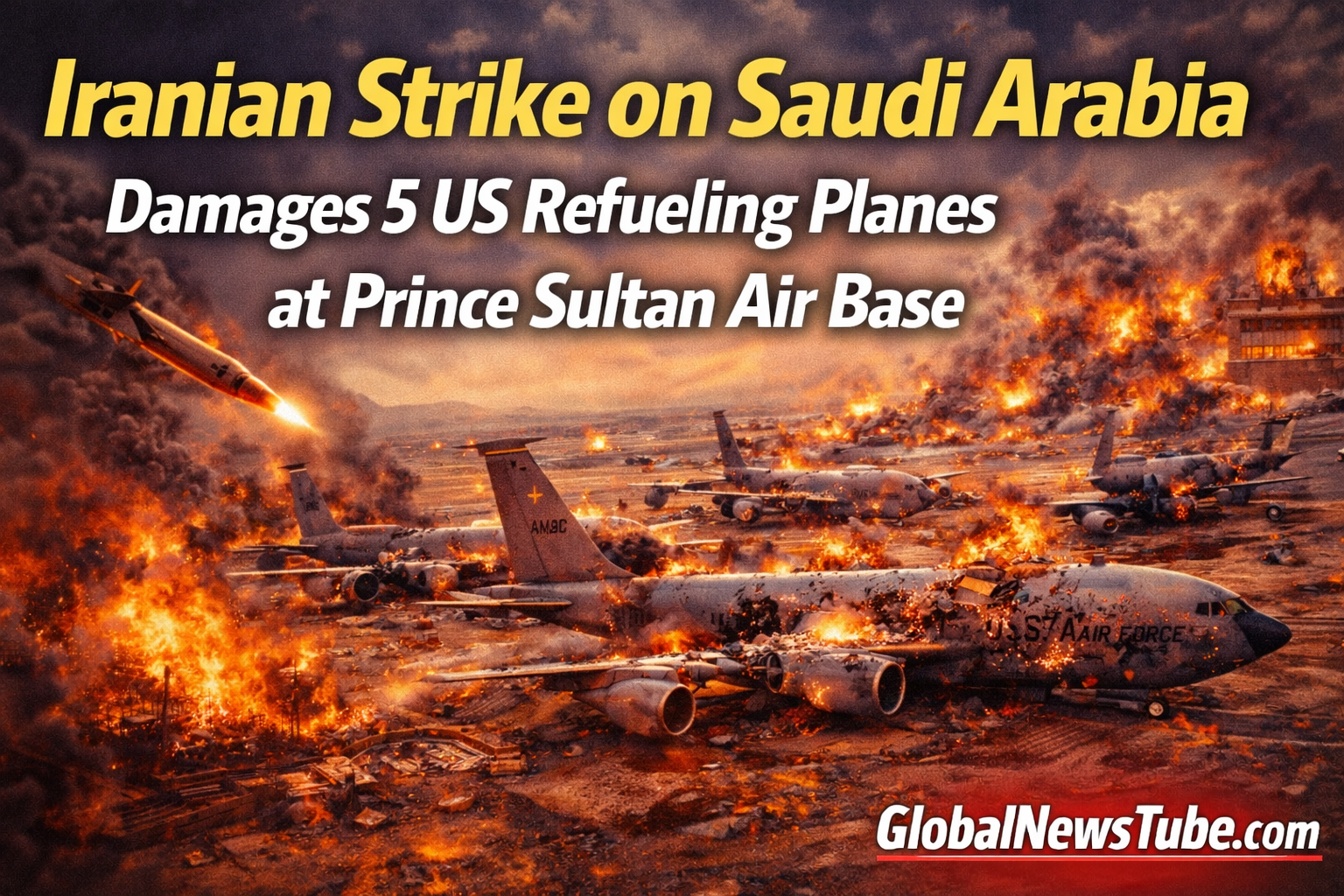
Iranian Strike on Saudi Arabia Damages 5 US Refueling Planes at Prince Sultan Air Base
A reported Iranian strike on Saudi Arabia has raised fresh concerns about the widening scale of conflict in the Middle East after five U.S. Air Force refueling aircraft were damaged at Prince Sultan Air Base. The incident is significant not only because of the number of aircraft affected, but also because of what those planes represent in modern warfare. Refueling aircraft are among the most important support assets in any air campaign, and damage to them can affect operational reach, mission timing, and overall military flexibility.
The strike highlights a growing reality in the region military infrastructure once assumed to be relatively secure is no longer beyond reach. Bases, logistics hubs, support aircraft, and energy related facilities are increasingly vulnerable in a conflict environment shaped by long range missiles, drones, and rapid retaliation. If confirmed in full detail, this attack will be viewed as more than an isolated battlefield event. It will be seen as a signal that strategic support systems are becoming direct targets in a broader regional confrontation.
Why Prince Sultan Air Base Matters
Prince Sultan Air Base has long been an important site for U.S. military operations in Saudi Arabia. Its role in hosting American forces gives it importance well beyond its physical location. It functions as a strategic platform that supports air missions, surveillance, planning, and coordination across the Gulf. When a base like this comes under attack, the implications go beyond local damage. It sends a message about reach, intent, and vulnerability.
The reported damage to five tanker aircraft makes the incident especially important. These planes are not front line fighter jets, yet they are indispensable to front line air power. Aerial refueling extends the range of combat aircraft, surveillance planes, and bombers, enabling operations over long distances without requiring those aircraft to land and refuel. In a region as geographically sensitive and militarily active as the Gulf, tanker aircraft play a central role in sustaining air operations.
When multiple refueling planes are damaged at the same location, planners are forced to think not just about repairs, but about the broader exposure of concentrated assets. The incident raises immediate questions about force protection, aircraft dispersal, and the resilience of support networks during a period of escalating hostilities.
The Strategic Importance of Refueling Aircraft
The fact that US refueling planes were hit in Saudi Arabia matters because tanker aircraft are essential to the overall architecture of air operations. They are not merely support tools operating in the background. They make sustained missions possible. Without them, fighter aircraft may be forced to reduce time over target areas, surveillance missions may have shorter windows, and long distance deployments may become more difficult to maintain.
In practical terms, damage to tanker planes can create bottlenecks. Commanders may have to reshuffle deployment patterns, move aircraft to alternate bases, or rely more heavily on a smaller number of operational refueling assets. That increases pressure on crews, changes sortie planning, and may reduce flexibility in responding to fast moving developments. In a crisis environment, these effects can be as important as the physical damage itself.
This is why attacks on support infrastructure often have an outsized impact. A damaged runway, radar site, or refueling fleet can affect operations far beyond the immediate location of the strike. Even when equipment is repairable, the disruption may still produce short term operational strain and strategic recalculation.
A Wider Pattern of Escalation
The reported Iranian strike on Saudi Arabia is also important because it fits into a much larger pattern of regional escalation. Tensions involving Iran, the United States, Israel, and Gulf states have increasingly spilled across borders, drawing in military installations and strategic facilities that were once considered secondary to the main battlefield. As a result, the distinction between frontline and rear area targets has become less meaningful.
Saudi Arabia occupies a particularly sensitive position in this environment. It is a major regional power, a security partner of the United States, and home to infrastructure that holds both military and economic importance. Any attack on Saudi territory carries implications far beyond bilateral tensions. It immediately affects calculations in Washington, across the Gulf, and among international observers concerned about energy markets, maritime security, and regional stability.
This makes the attack on Prince Sultan Air Base especially concerning. If support aircraft at a major Saudi base can be struck, similar facilities could also come under greater threat. Airbases, logistics centers, energy infrastructure, airports, and command facilities may all be viewed as viable targets in an expanding conflict. That possibility increases pressure on both the United States and regional allies to harden facilities, improve layered air defense, and rethink how critical assets are distributed.
Military and Political Consequences
The consequences of such a strike are likely to be both military and political. Militarily, it may push the U.S. to disperse aircraft more widely, rotate tanker assets more carefully, and strengthen protection measures around non combat but high value platforms. Strategically, it may alter how the region is viewed as an operating environment. No matter how capable the air defenses are, repeated attacks can create uncertainty and force changes in posture.
Politically, the symbolism is powerful. Damage to five refueling aircraft shows that Iran or Iran linked forces may be willing to strike assets that are directly tied to U.S. operational capability. That creates pressure for a response, or at minimum for visible steps to restore confidence in regional defenses. It also places Saudi Arabia in a difficult position, as the kingdom must balance its own security concerns with the broader risk of being pulled deeper into direct confrontation.
This is one reason why attacks on logistical and support assets matter so much. They affect morale, signal capability, and test the credibility of existing defense arrangements. In modern conflict, the battlefield is not defined only by direct combat zones. It includes the networks that make combat possible.
What Happens Next
The immediate issue is whether the damage to these aircraft changes the U.S. military posture in the Gulf. It would not be surprising to see adjustments in basing, asset dispersal, and protective measures around tanker fleets and other high value support platforms. Military planners are likely to focus on reducing concentration risk and ensuring that critical operations can continue even if one site is disrupted.
At the same time, the broader regional impact may be even more important. This strike underscores how rapidly the conflict can widen, and how support systems can become central targets in a prolonged confrontation. Even if the damaged aircraft are repaired and returned to service, the strategic message will remain.
The reported attack on Prince Sultan Air Base is a reminder that in today’s Middle East security environment, logistics are no longer safely behind the front lines. They are now part of the contest itself. That makes this incident more than a tactical development. It is a warning about the direction of the conflict and the growing risks facing every state connected to it.