


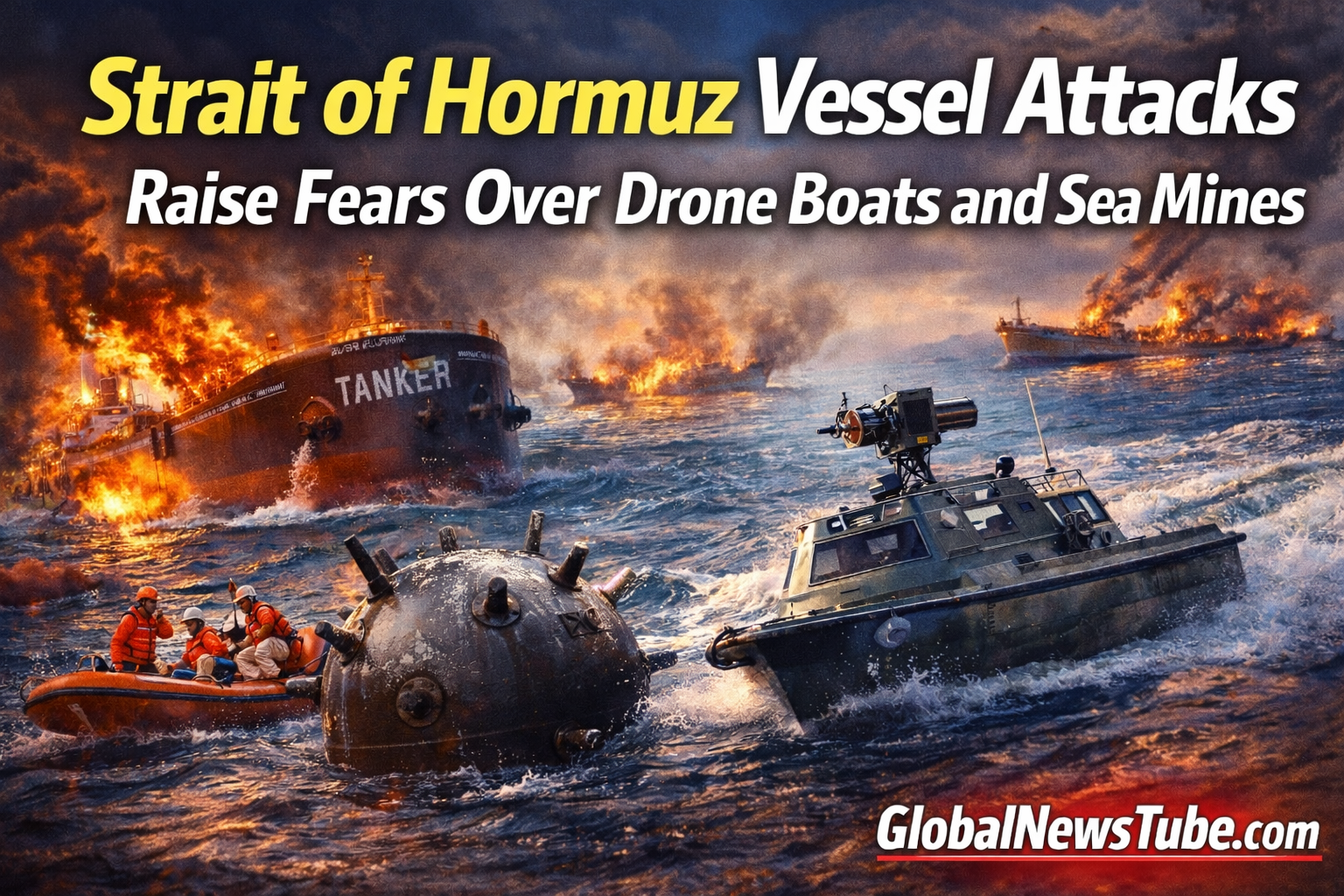
Strait of Hormuz Vessel Attacks Raise Fears Over Drone Boats and Sea Mines
The latest Strait of Hormuz vessel attacks have sharply raised fears about maritime security in one of the world’s most important energy corridors. At least six vessels were reportedly hit in a wave of incidents stretching from Iraqi waters to the Strait of Hormuz and nearby Gulf shipping lanes. Two fuel tankers caught fire in Iraqi waters, while additional ships were struck by projectiles near the United Arab Emirates and inside or near the strait itself.
This matters because the Strait of Hormuz vessel attacks are not just isolated shipping incidents. They come amid reports that Iran may have used explosiven laden drone boats and deployed sea mines in or around the key waterway. The growing danger at sea is now adding a new and serious layer to the wider regional conflict.
Why the Strait of Hormuz Vessel Attacks Matter
The reason these Strait of Hormuz vessel attacks matter so much is simple the waterway is one of the most critical chokepoints in the global energy system. Roughly one-fifth of the world’s oil and gas passes through the Strait of Hormuz. Any disruption there can quickly affect tanker traffic, fuel prices, shipping insurance, refinery planning, and energy security far beyond the Middle East.
That gives this story immediate global relevance. When commercial vessels are hit in or near Hormuz, the risk is not limited to one company or one country. It creates uncertainty across shipping routes and raises the possibility of broader economic fallout.
Two Tankers Set Ablaze in Iraqi Waters
The most dramatic part of the report involves two fuel tankers hit in Iraqi waters. The Marshall Islands flagged Safesea Vishnu and Zefyros, both loaded with fuel cargoes in Iraq, were targeted in late night attacks. One crew member was reported dead, while 25 crew members were rescued from the two vessels. Fires were still burning on both ships during the aftermath.
The attacks also affected oil operations. Iraqi port authorities halted oil terminal activity, although commercial ports reportedly continued functioning. These details make the oil tanker attacks Iraq angle especially important because the incident involved not only vessel damage, but also loss of life, rescue operations, and direct consequences for energy trade.
Iranian Drone Boats and Sabotage Concerns
A major reason this story has gained attention is the growing concern over Iranian drone boats. Officials described the attacks on the two tankers as sabotage, while reports suggested that explosive laden unmanned surface vessels may have been used in the assault.
This is a significant development because unmanned explosive boats are harder to track than conventional naval assets and can still create major disruption. If the reported use of drone boats is accurate, it would mark a dangerous escalation in maritime tactics across Gulf waters.
That also makes Iran maritime sabotage an important part of the story. The conflict is no longer limited to missiles and drones in the air. It is increasingly moving into commercial sea lanes, where oil tankers and cargo vessels are exposed to attack.
Sea Mines in Hormuz Add to Shipping Fears
The fear of sea mines in Hormuz may be even more serious. Reports suggest that mines may have been deployed in the strait, raising concern among shipowners, energy companies, and military planners.
If mines are indeed present, the implications are severe. Mines can threaten any commercial vessel passing through the area, slow traffic even without direct hits, and force insurers, shipowners, and governments to rethink risk exposure immediately.
This is one reason the Strait of Hormuz vessel attacks story is so important. Even the possibility of mines can disrupt shipping patterns and send shockwaves through global energy markets.
More Ships Hit Near the UAE and in the Strait
The danger was not limited to the Iraqi tanker fires. A container ship north of Jebel Ali in the UAE was reportedly struck by a projectile, causing a small fire. The Thai-flagged dry bulk vessel Mayuree Naree was hit by two projectiles in the strait, causing a fire and engine-room damage, with crew members reported missing and feared trapped.
Other vessels also suffered damage. The Japan flagged container ship ONE Majesty sustained minor damage near Ras Al-Khaimah, and the Marshall Islands flagged Star Gwyneth was also reportedly struck northwest of Dubai. In those cases, crews were said to be safe.
This broader pattern explains why Gulf shipping attacks is such a useful keyword for the story. The incidents were spread across multiple locations and vessel types, showing a wider maritime threat rather than one isolated event.
Wider Impact on Oil and Trade
The economic stakes are high. Vessel strikes, halted oil terminal activity, and growing concern over safe passage through the Strait of Hormuz all point to a deeper shipping crisis.
If this pattern continues, the effect could extend beyond maritime risk to fuel supply concerns, freight disruption, and higher insurance costs. Oil markets are especially sensitive to instability in the Gulf, and any serious interruption in shipping can influence prices far beyond the region.
That is why the Strait of Hormuz vessel attacks are not only a military story. They are also a trade and energy story with global consequences.
Conclusion
The Strait of Hormuz vessel attacks story is about far more than a few damaged ships. It reflects a dangerous escalation in Gulf maritime conflict, with tanker fires, reported drone boat sabotage, possible sea mine deployment, and rising pressure on one of the world’s most critical oil routes.
Commercial shipping is now directly exposed to the widening regional war. That makes this one of the most serious maritime security developments in the Gulf in recent years. As the situation unfolds, the focus keyword Strait of Hormuz vessel attacks remains the strongest way to capture the central issue multiple ships attacked, vital shipping lanes threatened, and growing fears of a broader oil and maritime crisis.